

Oct 2026
When someone you love is critically ill, every minute feels long. The doctor says the patient needs to be moved, maybe to a bigger hospital, maybe to a unit with better critical-care facilities, and suddenly you are making phone calls while trying to stay calm. Most families in this situation have never booked an ICU ambulance before. They don’t know what to ask, what to keep ready, or how to tell a properly equipped vehicle from an ordinary one.
This guide is written for exactly that moment. It explains, step by step, how to find an ICU ambulance near you in Kolkata, what to say on the first call, what to check before you confirm, and how to coordinate with hospitals. If the patient is deteriorating right now, do not keep reading. Call a local emergency service or the treating doctor first, and come back to this guide afterwards.
If you need help right away, you can call Uttam Ambulance on 9163483982 or 9836035945, explain the patient’s condition, and ask what support is available for your pickup point.
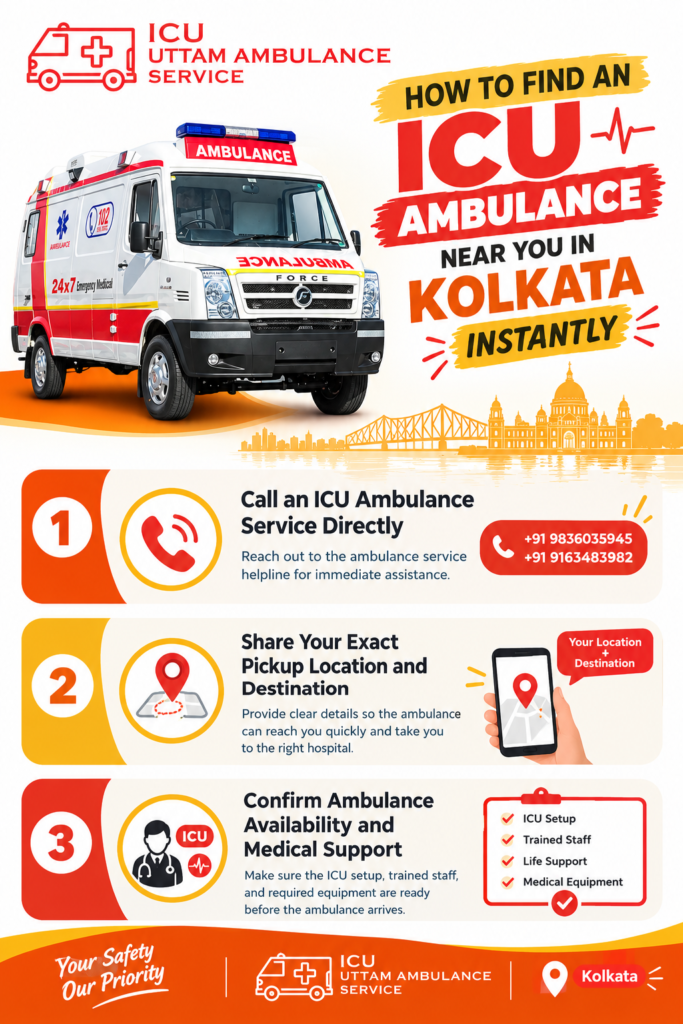
How to Find an ICU Ambulance Near You in Kolkata Instantly
The fastest way to arrange an ICU ambulance is a direct phone call, not a form, not a chat bot, and not a long comparison of websites. Speaking to someone who can tell you what is available right now saves time and avoids confusion. Here is a simple process to follow.
A quick note on timing: no honest provider can promise an arrival time before checking where the vehicle currently is and the traffic on that route. Always ask for an estimate and treat it as an estimate.
Call an ICU Ambulance Service Directly
Call the service and begin with the most important facts: who the patient is, what the problem is, and where they are. Keep your first few sentences short and clear. For example: “Patient is on oxygen at a hospital in Salt Lake and needs to move to a hospital in Garia. We need an ICU ambulance.”
Direct communication helps because the person on the phone can ask follow-up questions immediately, such as whether the patient is on a ventilator or needs a stretcher. Messages and online forms often get answered late, and in an emergency that delay matters. Save the number you called so the driver or coordinator can reach you back.
Share Your Exact Pickup Location and Destination
A vague address is the most common reason ambulances lose time. Give the following details:
- Full address with house, building or hospital name
- A nearby landmark that is easy to spot
- Floor number and whether a lift is available
- Any narrow lane, gate or parking restriction
- The destination hospital’s name and area
If you can, share your location on WhatsApp or a map link after the call. It helps the driver find you without repeated phone calls.
Confirm Ambulance Availability and Medical Support
Once the location is shared, ask directly:
- Is an ICU ambulance available now for my pickup point?
- Does it carry oxygen, and is ventilator support available if my patient needs it?
- Is there monitoring equipment on board?
- Who will travel with the patient: a trained attendant or a medical professional?
- What is the estimated arrival time?
When Do You Need an ICU Ambulance in Kolkata?
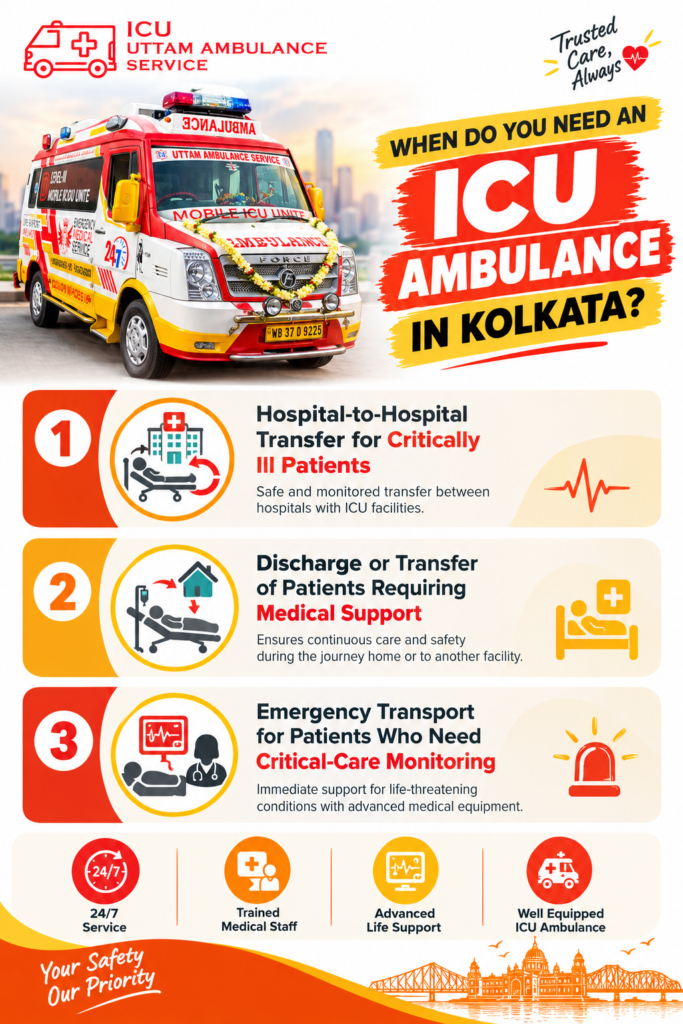
An ICU ambulance is meant for patients whose condition may change during the journey and who need ongoing monitoring or life support. Whether your patient actually needs one depends on their clinical condition, so always follow the advice of the treating doctor. If you are unsure, ask the doctor: “Does this patient need a critical-care ambulance, or is a basic one enough?”
Hospital-to-Hospital Transfer for Critically Ill Patients
This is the most common reason families book an ICU ambulance. A patient may need to move because the current hospital does not have the required specialist, a free ICU bed, or advanced equipment such as dialysis or cardiac support. During such a transfer, the patient’s oxygen, medication drips and vital signs must be watched continuously, which a regular ambulance is usually not set up to do.
Discharge or Transfer of Patients Requiring Medical Support
Some patients are discharged from hospital but still depend on oxygen, suction or breathing support, for example after a long ICU stay, a stroke, or a serious lung illness. Travelling home in a private car can be risky for them. In these cases the doctor may advise a medically equipped ambulance so that support continues until the patient is settled at home or in a care facility.
Emergency Transport for Patients Who Need Critical-Care Monitoring
Patients who have severe breathing difficulty, low oxygen levels, chest pain, serious injuries, or reduced consciousness may need oxygen, ventilatory support or continuous monitoring on the way to hospital. If the patient looks unstable, please do not try to self-transport in a taxi or private vehicle. Seek emergency medical assessment first and let trained people handle the move.
What Should You Check Before Booking an ICU Ambulance?
In an emergency it is tempting to book whichever vehicle is closest or cheapest. But the right ambulance is the one that matches the patient’s needs. Use this checklist while you are on the phone.
Essential Life-Support and Monitoring Equipment
Equipment needs differ from patient to patient. Ask the provider to confirm the specific items your doctor has advised, which commonly include:
- Oxygen cylinder with a mask or nasal support
- Ventilator support, if the patient needs it
- Cardiac or vital-signs monitor
- Suction machine
- Stretcher and basic emergency supplies
Do not assume everything is included. Ask about each item that matters for your patient.
Trained Medical Staff During Transportation
Equipment is only useful if someone knows how to use it. Ask who will accompany the patient: a doctor, a nurse, or a trained paramedic or attendant. The right level of staff depends on the patient’s condition, so check with the treating team if you are unsure. It is perfectly reasonable to ask about their experience with patients like yours.
Ambulance Availability, Arrival Time, and Route
Confirm that the ambulance has actually been dispatched, not just “arranged.” Ask for an approximate arrival time, whether the destination hospital’s entrance is easy to reach, and whether known traffic or road work could cause delay. Kolkata traffic can change quickly, so ask the driver to keep you updated.
ICU Ambulance Charges and What Is Included
Ask for a clear quote before you confirm. Charges can vary depending on the distance and what the patient needs. Ask about:
- Base fare
- Per-kilometre or distance charges
- Medical staff fees
- Oxygen or equipment charges
- Waiting time charges
- Any additional costs, such as tolls or night charges
A transparent provider will explain these without hesitation.
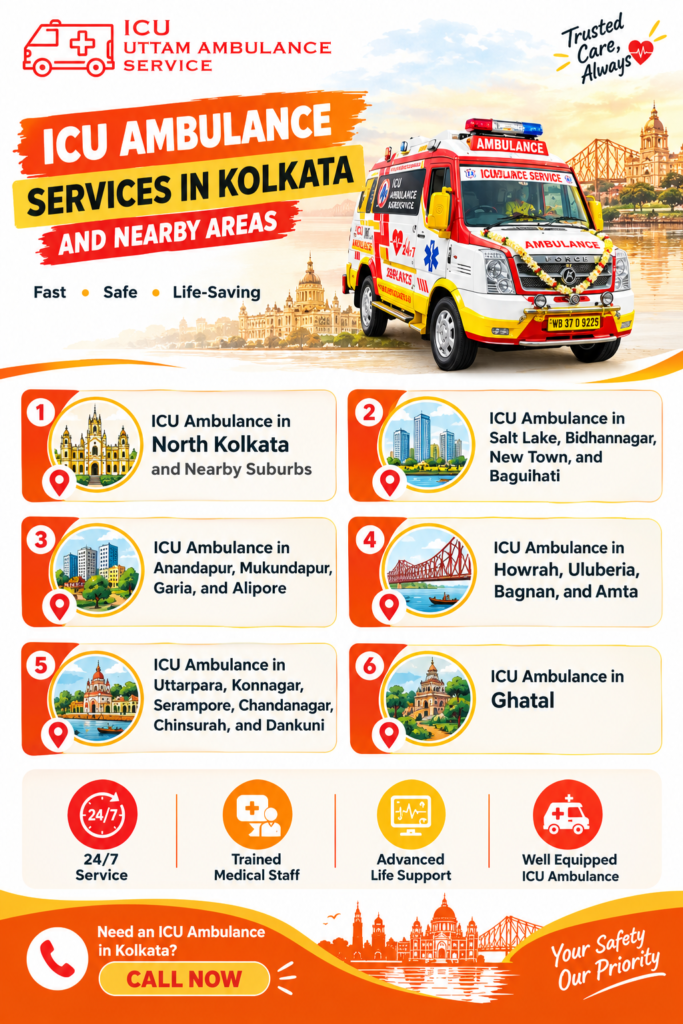
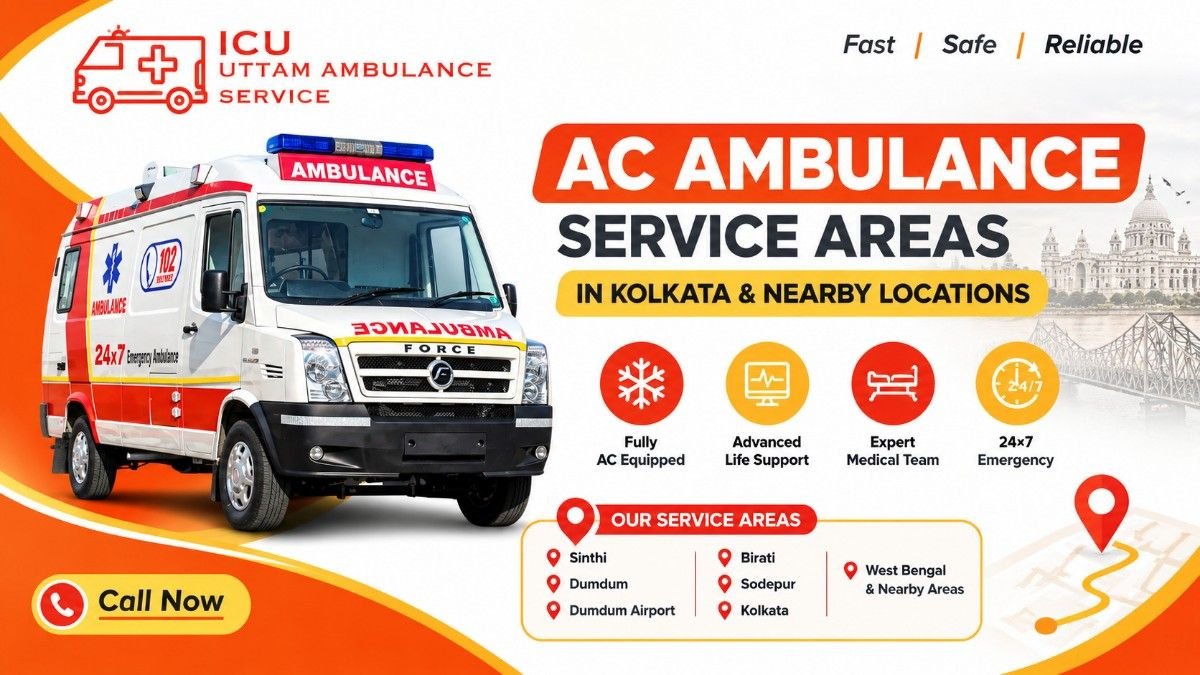
ICU Ambulance Services in Kolkata and Nearby Areas
Patients who need critical-care transport are not only in central Kolkata. Many families call from the suburbs, from satellite towns, and from districts around the city. Below are the areas where people commonly search for an ICU ambulance. Availability and response time in each area depend on where the ambulance is at that moment, so always confirm with the provider before assuming anything.
ICU Ambulance in North Kolkata and Nearby Suburbs
Families in Barasat, Madhyamgram, Barrackpore and Kalyani often need to move patients to larger hospitals in the city or to specialist centres. When you call for an ICU ambulance from these areas, tell the coordinator the exact pickup point (house, nursing home or hospital) and the hospital you are heading to. Response time depends on the ambulance’s current location, so ask for an honest estimate instead of a promise.
ICU Ambulance in Salt Lake, Bidhannagar, New Town, and Baguihati
This part of the city has many residential complexes, nursing homes and hospitals, and families here regularly need critical-care transport between them or to hospitals across the city. Whether you are looking for an ICU ambulance in Salt Lake, Bidhannagar, New Town (Newtown) or Baguihati, share the sector, block or housing complex name along with a landmark, since addresses in these areas can be confusing for a driver arriving for the first time.
ICU Ambulance in Anandapur, Mukundapur, Garia, and Alipore
From the south and south-east of the city, Anandapur, Mukundapur, Garia and Alipore see a lot of home-to-hospital and hospital-to-hospital transfers. Be clear about the starting point and the receiving hospital. Before the ambulance leaves, confirm that it can physically reach your pickup location, since narrow lanes and parking-restricted buildings can affect access, and that it can support the patient’s clinical needs.
ICU Ambulance in Howrah, Uluberia, Bagnan, and Amta
For transfers starting in Howrah, Uluberia, Bagnan or Amta, accurate pickup details and the receiving hospital’s location are especially important, because the route often involves bridges and longer distances. Please confirm coverage, journey time and charges with the provider directly. Do not rely on a general claim that every area is covered or that a specific arrival time is guaranteed.
ICU Ambulance in Uttarpara, Konnagar, Serampore, Chandanagar, Chinsurah, and Dankuni
Across the Hooghly side, including Uttarpara, Konnagar, Serampore, Chandanagar, Chinsurah and Dankuni, families often arrange transfers to Kolkata hospitals or to facilities in other districts. When you call, confirm four things: whether a vehicle is available, whether your destination is covered, what medical support will be on board, and how long the journey is expected to take. Getting these answers on the phone avoids surprises later.
ICU Ambulance in Ghatal
If you need critical-care transport from Ghatal to a suitable hospital, plan ahead as much as the situation allows. Longer-distance transfers need coordination: confirm that the patient is clinically fit for the journey with the treating doctor, check that the ambulance has the right equipment and staff for a long trip, and get a clear estimate of travel time and total charges before the ambulance sets out.
How to Book an ICU Ambulance for Hospital-to-Hospital Transfer
If you already know where the patient is and where they need to go, follow this workflow so the transfer is smooth.
Keep the Patient’s Medical Information Ready
Be ready to share the patient’s current condition, whether they can move or are bedridden, their oxygen or ventilator requirements, and any specific instructions from the treating team. This helps the ambulance team prepare the right equipment and staff before they arrive.
Confirm Acceptance With the Receiving Hospital
Before the patient leaves, make sure the receiving hospital has agreed to admit them. Confirm bed availability, the correct department (ICU, emergency, cardiology and so on) and who will receive the patient on arrival. Skipping this step can leave a critically ill patient waiting at the gate.
Coordinate With the Referring Hospital and Ambulance Team
Ask the current hospital to prepare the discharge or transfer summary, recent reports, scans and medication details, and to give a proper handover to the ambulance team before departure. Keep copies of the documents with the attendant travelling with the patient.
What Information Should You Keep Ready When Calling an ICU Ambulance?
Under stress, it is easy to forget details. Keep this list in front of you when you dial:
- Patient’s current location and exact pickup address
- Destination hospital and department, if known
- Patient’s condition and level of consciousness, if known
- Oxygen, ventilator or other support requirements
- Patient’s mobility and any special transfer needs
- Contact number of the attendant or referring hospital
- Preferred pickup time, if the transfer is planned
- Any available medical instructions or transfer documents
If you do not have all of this, call anyway. Do not delay emergency assistance to collect paperwork. The ambulance team can work with what you have, and documents can follow.
Frequently Asked Questions About ICU Ambulance Services in Kolkata
How Can I Find an ICU Ambulance Near Me in Kolkata Quickly?
Call an ambulance service directly rather than searching through many websites. Share the patient’s condition, exact pickup address and destination hospital. Then ask whether an ICU ambulance is available now, what equipment and staff it carries, and the estimated arrival time. Uttam Ambulance can be reached on 9163483982 or 9836035945.
Can I Book an ICU Ambulance From Kolkata to Another City?
Intercity transfers can often be arranged, but it depends on the provider’s coverage, the patient’s condition, the medical staff available for a long journey, and arrangements at the destination. Speak to the provider in advance, share the patient’s details and confirm the estimated journey time and charges before booking.
What Is the Cost of an ICU Ambulance in Kolkata?
The charge depends on distance, the equipment needed, whether medical staff travel with the patient, waiting time and any provider-specific fees. Because every transfer is different, there is no single fixed price. Ask for a clear quote that lists what is included before you confirm the booking.
Is an ICU Ambulance Available 24/7 in Kolkata?
Availability differs by provider and by the hour. Do not assume round-the-clock service. Call the specific ambulance service and ask whether a vehicle is available at that moment, particularly at night, and confirm operating hours so you are not caught off guard during an emergency.
Can I Book an ICU Ambulance From Barasat, Howrah, or Salt Lake?
You can ask. Call the provider, give your exact pickup location in Barasat, Howrah or Salt Lake, and name the destination hospital. They can confirm whether they cover the area, whether a vehicle is free, and how long the route is likely to take given current traffic.
What Is the Difference Between a Normal Ambulance and an ICU Ambulance?
A normal ambulance mainly provides transport and basic first aid. An ICU ambulance is set up for patients who need more advanced monitoring or critical-care support, such as oxygen, cardiac monitoring or ventilator support. The exact equipment and staff vary by vehicle and provider, so always ask what is on board.
What Should I Do if the Patient’s Condition Is Deteriorating?
Contact local emergency services or a qualified medical professional immediately. Do not spend time comparing providers or collecting documents. If the patient has trouble breathing, becomes unresponsive or worsens quickly, urgent medical help comes first, and ambulance coordination can happen alongside it.
Book an ICU Ambulance in Kolkata — Get Immediate Assistance
If a patient needs critical-care transport, pick up the phone and speak to someone who can help right now. Tell them where the patient is, where they need to go, and what condition they are in. Then confirm the medical support on board, the estimated arrival time and the charges before the ambulance leaves.
Call Uttam Ambulance: 9163483982 | 9836035945




Leave a Reply