
Sep 2026
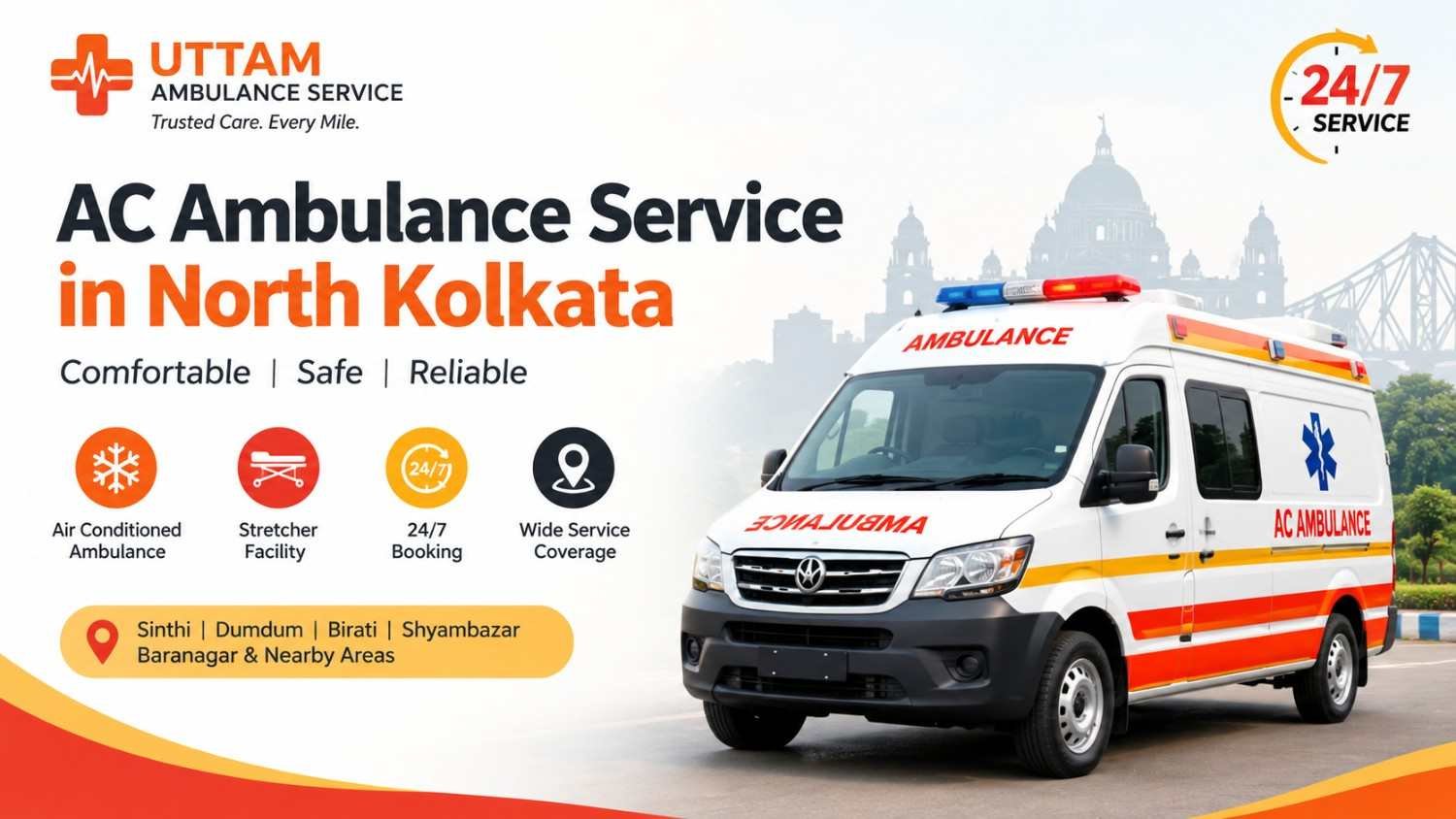
When a loved one needs to be moved from a hospital, nursing home, or residence, comfort during the journey matters just as much as reaching the destination on time. A patient recovering from surgery, an elderly parent going for a check-up, or someone being discharged after a long hospital stay all need transportation that doesn’t add stress to an already difficult day. This is where an AC ambulance service in North Kolkata makes a real difference — offering a temperature-controlled, calmer ride during Kolkata’s heat, humidity, and traffic.
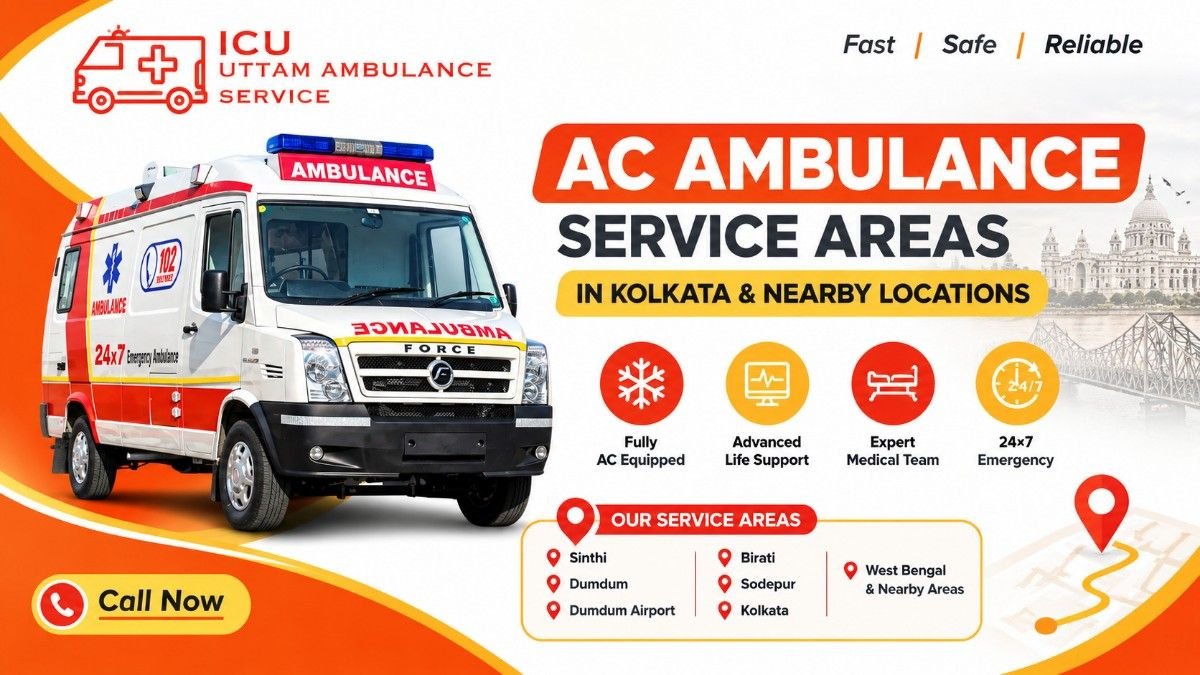
This guide covers everything you need to know about booking an AC ambulance across North Kolkata, including service availability in Sinthi, Dumdum, Airport, Birati, Shyambazar, Maniktala, Kankurgachi, Laketown, Cossipore, Baranagar, Belgachia, Patipukur, and Sovabazar.
Whether you need a hospital transfer, discharge transportation, help getting to a scheduled medical appointment, or an inter-hospital shift, understanding how this kind of non-emergency patient transport service works will help you make a calmer, more informed decision when it matters most. Throughout this guide, you’ll find practical details on AC ambulance booking, stretcher ambulance service, pricing factors, and how to pick a reliable ambulance provider in North Kolkata — everything a family typically needs before making that first call.
What Is an AC Ambulance Service?
An AC ambulance is, at its core, an ambulance with a temperature-controlled patient compartment. The main difference between an AC ambulance and a standard, non-AC ambulance isn’t the level of medical care — it’s the comfort of the ride itself. A cooler, more stable environment inside the vehicle can make a real difference to a patient who is already unwell, in pain, or anxious about the journey.
It’s worth understanding that equipment and staffing can vary quite a bit from one ambulance and provider to another. Some AC ambulances are set up for straightforward, non-emergency patient transport, while others may carry additional medical supplies or trained personnel. There’s no single, universal standard — so it always helps to ask the provider directly what their specific vehicle includes before you book.
Why Air Conditioning Matters During Patient Transportation
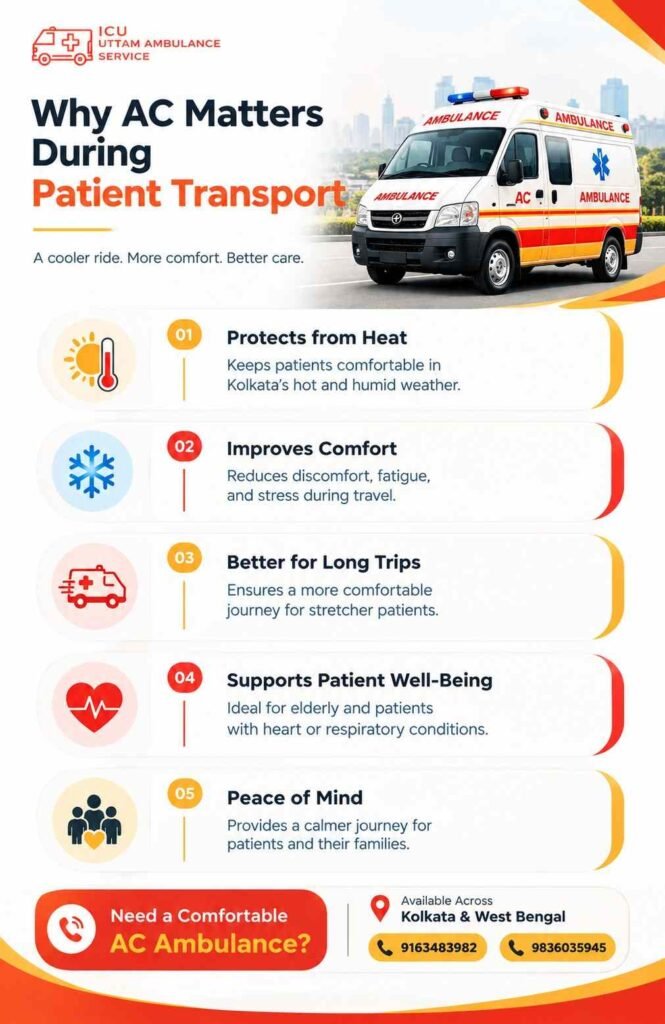
Kolkata’s weather is a real factor in patient transport, not just a minor inconvenience. A few practical reasons AC matters:
- Heat and humidity in Kolkata, especially between March and September, can be genuinely hard on someone who is already weak, dehydrated, or recovering from a procedure.
- Patient comfort improves noticeably in a cooler, quieter compartment — this matters for patients who are in pain, feeling nauseous, or simply exhausted.
- Longer-distance transportation becomes far more tolerable in a controlled environment, especially if the patient needs to lie flat on a stretcher for an extended period.
- During Kolkata’s warmer months, an un-air-conditioned vehicle can add unnecessary physical stress to a patient’s body, particularly for elderly patients or those with cardiac or respiratory conditions.
- A stable, comfortable environment inside the ambulance can also make the ride less stressful for family members accompanying the patient.
In short, air conditioning isn’t a luxury add-on — for many patients, it’s a practical necessity for a safer, more comfortable transfer.
AC Ambulance Service Areas in North Kolkata
Patients and families across North Kolkata regularly need ambulance transportation — not just for emergencies, but for planned hospital visits, discharge from a nursing home, transfers between hospitals, and pickups from residences, clinics, railway stations, and the airport. Below is a locality-wise look at how AC ambulance transportation typically applies across the region.
i) AC Ambulance in Sinthi:
Sinthi is a busy residential and commercial pocket of North Kolkata, and families here often need ambulance support for routine hospital visits, post-surgery discharge, or moving an elderly family member to a scheduled appointment. Because Sinthi sits close to several major North Kolkata roads, an AC ambulance can usually reach homes and apartment complexes in the area without much delay, making it a practical option for both planned and same-day transportation needs. When booking, it helps to share your exact building or lane details, since many residential blocks in the area can be hard to locate without clear directions.
ii) AC Ambulance in Dumdum:
Dumdum is one of North Kolkata’s most well-connected localities, home to both a major railway station and Kolkata’s airport. This means ambulance requirements here are often a mix of routine hospital transfers and transportation tied to travel — picking up a patient arriving by train or flight, or dropping someone off for a journey. Families in Dumdum arranging an AC ambulance should mention whether the pickup or drop point is near the station, a residential lane, or the airport area, since this affects route planning and timing.
iii) AC Ambulance Service Near Kolkata Airport:
Patients sometimes need medically appropriate ground transportation immediately before or after air travel — for example, someone travelling to Kolkata for treatment, or a patient being flown out for specialised care elsewhere. In these situations, an AC ambulance can offer a more comfortable, controlled ride to or from the airport compared to a regular taxi. That said, any pickup or drop-off arrangements at the airport itself, including terminal access, should always be confirmed directly with your ambulance provider in advance — these arrangements can vary and shouldn’t be assumed.
iv) AC Ambulance in Birati:
Birati, a growing residential suburb in North Kolkata, sees a steady need for patient transportation to hospitals and nursing homes located further into the city. Many families here are looking for a dependable way to move elderly parents or patients with limited mobility for regular check-ups or specialist consultations. An AC ambulance can be a more comfortable alternative to a private car for these routine but important trips, particularly during the hotter months.
v) AC Ambulance in Shyambazar:
Shyambazar is a busy, centrally located part of North Kolkata, and patient transfers here often involve navigating dense traffic and narrow lanes. Whether it’s a transfer between two medical facilities or bringing a patient home after a hospital stay, having a stretcher-equipped, air-conditioned ambulance can make the process considerably smoother for both the patient and accompanying family members.
vi) AC Ambulance in Maniktala:
Maniktala’s mix of residential neighbourhoods and nearby medical facilities means ambulance requests here frequently involve short-distance transfers — from home to a clinic, or between a diagnostic centre and a hospital. Booking an AC ambulance in advance for scheduled appointments in Maniktala can help avoid last-minute stress, especially for patients who need to travel lying down or who tire easily.
vii) AC Ambulance in Kankurgachi:
Kankurgachi residents often need ambulance support for hospital transfers, planned medical appointments, and discharge transportation. Because this area connects fairly easily to several other parts of North and Central Kolkata, an AC ambulance based nearby can usually respond to both scheduled bookings and same-day requests without major delays.
viii) AC Ambulance in Laketown:
Laketown is a well-established residential area, and many families here need ambulance transportation for elderly parents managing ongoing health conditions. Common situations include moving a patient between hospital visits, arranging transport after a fall or minor injury, or simply providing a more comfortable ride than a personal vehicle can offer for someone recovering from illness.
ix) AC Ambulance in Cossipore:
Cossipore’s mix of older residential lanes and industrial stretches means clear address details are especially important when arranging transport here. Families needing to move a patient from a home in Cossipore to a hospital, or between healthcare facilities, should share precise location details when booking, so the ambulance can plan the most efficient route through the area.
x) AC Ambulance in Baranagar:
Baranagar sees a fairly wide range of patient transportation needs, from routine appointments to more involved hospital-to-hospital transfers. Given the area’s proximity to several healthcare facilities, families often look for an AC ambulance that can respond reasonably quickly while still confirming the exact type of vehicle and support needed for the patient’s specific condition.
xi) AC Ambulance in Belgachia:
Belgachia is close to some of North Kolkata’s key medical institutions, which means ambulance bookings here often involve short, planned transfers rather than long-distance travel. Even for short trips, a temperature-controlled ambulance can matter — particularly for patients who are frail, in pain, or need to remain on a stretcher throughout the journey.
xii) AC Ambulance in Patipukur:
In Patipukur, transportation requests typically come from families managing ongoing care for elderly relatives or patients recovering at home. When booking, it’s worth clearly explaining the patient’s mobility level and any specific needs — such as whether they can sit upright or must remain lying down — so the provider can send an appropriately equipped vehicle.
xiii) AC Ambulance in Sovabazar:
Sovabazar, one of North Kolkata’s older and more densely populated neighbourhoods, often has narrower access roads, which makes clear pickup instructions especially important. Families arranging an AC ambulance from Sovabazar should confirm the nearest accessible point for the vehicle, particularly if the residence is deep inside a lane, to avoid delays during pickup.

When Should You Book an AC Ambulance in North Kolkata?
A common question families ask is simple: do we actually need an AC ambulance, or will a regular car do? Here’s a practical breakdown of situations where an AC ambulance typically makes sense.
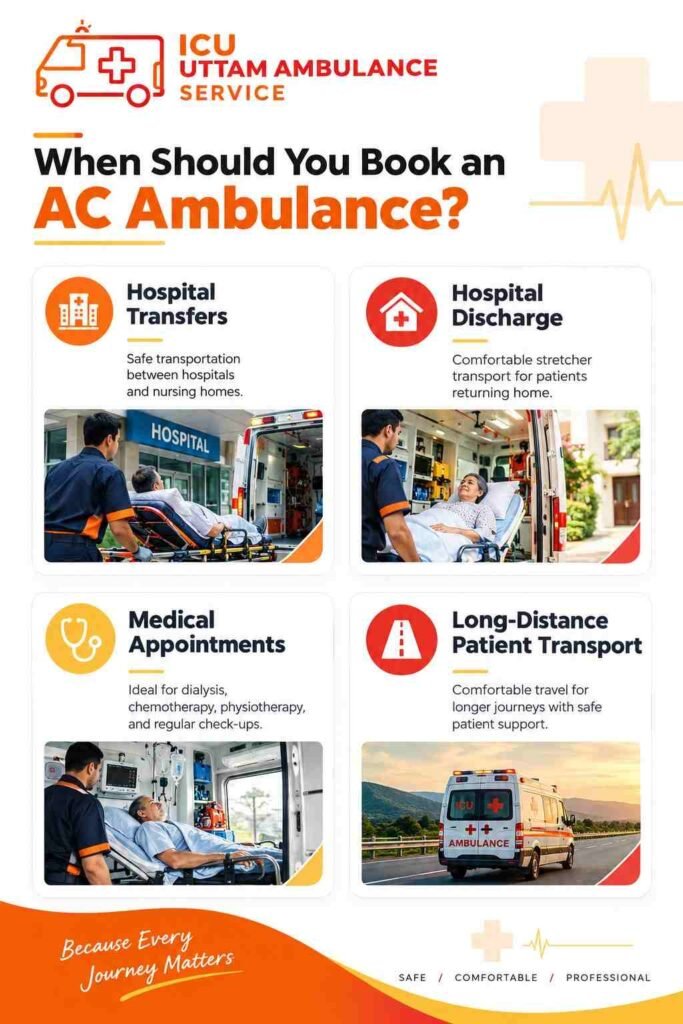
i) Hospital-to-Hospital Patient Transfer
When a patient is being moved from one hospital or nursing home to another, choosing the right ambulance category is important. A patient who needs to remain flat, is on oxygen, or requires monitoring during the transfer needs a vehicle and setup appropriate to their condition — not just any air-conditioned car. Always share the patient’s current medical status with the ambulance provider so they can match the vehicle to the transfer.
ii) Hospital Discharge and Going Home
Not every discharged patient can comfortably sit upright in a private car for the ride home. Someone recovering from major surgery, a fracture, or a serious illness may need to travel lying down, in a cooler and more controlled environment. An AC ambulance with a stretcher can make this part of the recovery journey far less painful and stressful.
iii) Medical Appointments and Follow-Up Visits
Regular dialysis sessions, chemotherapy follow-ups, physiotherapy, or specialist consultations often involve patients who tire quickly or have limited mobility. For these recurring trips, an AC ambulance offering assisted transportation can take a significant physical and emotional burden off both the patient and the family.
iv) Long-Distance Patient Transportation
For longer journeys — say, moving a patient from North Kolkata to a hospital in another part of the city or state — a controlled, air-conditioned environment is usually far more comfortable over time than a standard vehicle. That said, patients requiring advanced medical support, continuous monitoring, or critical care during transit may need an ICU or advanced life-support ambulance rather than a standard AC ambulance. It’s important to be upfront about the patient’s condition so the right vehicle category is arranged.
AC Ambulance vs. Other Types of Ambulances
Not every patient transportation situation calls for the same type of vehicle. Here’s a simple way to think about it:
| Ambulance Type | Typical Use |
| AC Ambulance | Patient transportation where a temperature-controlled, comfortable environment is the priority |
| Basic Ambulance | General patient transportation and basic support, without a controlled climate setup |
| ICU / Advanced Life Support Ambulance | Patients requiring advanced monitoring, ventilator support, or critical care during transit |
| Non-Emergency Patient Transport | Planned transportation for stable patients who don’t need emergency response |
It’s important to be clear: air conditioning alone doesn’t mean a vehicle offers ICU-level medical care. Comfort and medical capability are two separate things, and understanding this distinction helps you choose the right ambulance category for your specific situation.
What Is Usually Available in an AC Ambulance?
Because equipment and staffing differ from provider to provider, it’s best to think of the following as a list of possible features rather than a guaranteed standard. Depending on the ambulance type and provider, you may find:
- A patient stretcher for lying-down transport
- Air conditioning in the patient compartment
- Basic medical supplies, such as first-aid materials
- Oxygen availability, if the vehicle is equipped for it and the provider offers it
- An attendant or medical personnel, depending on the service level booked
- Other equipment, depending on the ambulance category and the provider’s specific offering
Because this can vary so much, the safest approach is always to ask directly: “What equipment and staff does this specific ambulance have?” before you confirm a booking.
How to Book an AC Ambulance Service in North Kolkata
If you’re trying to arrange transportation quickly, here’s a simple, step-by-step process to make the booking process smoother.
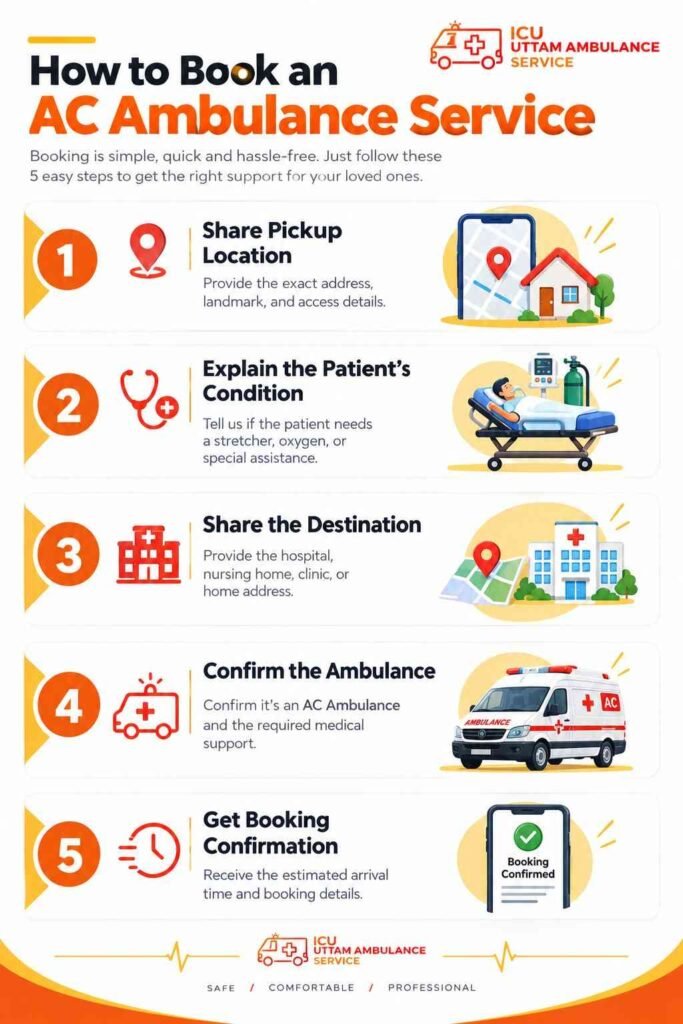
1. Share the Patient’s Pickup Location
Give the exact address, including locality, landmark, floor number, and any access details (like a narrow lane or gated complex) that might affect how quickly the ambulance can reach you.
2. Explain the Patient’s Condition
Let the provider know relevant details — whether the patient can sit up, needs to lie flat, is on oxygen, has mobility issues, or has any other condition that affects how they should be transported. This helps the provider send an appropriately equipped vehicle.
3. Provide the Destination
Clearly state where the patient needs to go — a specific hospital, nursing home, diagnostic centre, the airport, or a residence.
4. Confirm the Ambulance Type
Ask directly whether the ambulance is air-conditioned, and confirm what medical equipment and personnel (if any) will be present during the trip.
5. Confirm the Estimated Cost and Arrival Time
Before the ambulance is dispatched, ask for an estimated cost and arrival time. Keep in mind both can vary depending on distance, ambulance type, time of day, route conditions, and any additional services required.
How Much Does an AC Ambulance Cost in North Kolkata?
There’s no single fixed price for AC ambulance service — and any provider claiming a flat, one-size-fits-all rate should be approached with a little caution, since actual costs typically depend on several factors, including:
- Pickup location
- Destination
- Total distance travelled
- Ambulance category (basic AC, stretcher-equipped, ICU, etc.)
- Medical equipment required for the trip
- Whether an attendant or medical staff is needed
- Waiting time at pickup or destination
- Time of day (night or early-morning trips may be priced differently)
- Long-distance versus local travel
- Whether it’s a one-way trip or a round trip
Because pricing depends on so many variables, the most reliable way to know what you’ll actually pay is to share your pickup and destination details with the provider and request a direct quote before booking.
How to Choose the Right AC Ambulance for a Patient
It’s tempting to book the first available AC ambulance, but air conditioning alone shouldn’t be the deciding factor. Before confirming, it’s worth running through a quick checklist:
- Is air conditioning actually available in this specific vehicle?
- What type of ambulance is being sent — basic, stretcher-equipped, or ICU?
- Is a stretcher available, if the patient needs to lie down?
- Is oxygen available, if the patient requires it?
- Is trained medical staff available, if the situation calls for it?
- Can this ambulance realistically accommodate the patient’s specific condition?
- How soon can the ambulance arrive?
- What exactly is included in the quoted price?
- Is this ambulance category suitable for the distance being travelled?
Taking a few minutes to confirm these details can prevent a stressful situation from becoming worse.
Documents and Details to Keep Ready Before Booking
Having a few basics ready before you call can save valuable minutes, especially if the family is already stressed. It generally helps to keep the following within reach:
- The patient’s ID proof and any hospital ID or admission card, if the transfer is between two facilities
- Recent prescriptions or discharge summary, so the ambulance staff have some context on the patient’s condition
- A working contact number for whoever will be receiving the patient at the destination
- Details of any ongoing medical equipment the patient is using, such as an oxygen mask or IV line, so the vehicle can be prepared accordingly
- Information about who will accompany the patient, since most providers allow one attendant to travel along
None of this needs to be elaborate — the goal is simply to make sure the ambulance team isn’t figuring things out for the first time at the patient’s doorstep.
What to Expect During Your AC Ambulance Ride
For families booking an ambulance for the first time, not knowing what happens next can add to the anxiety. In general, once you’ve confirmed the booking:
- The provider will usually share an estimated arrival time, which can shift slightly depending on traffic in areas like Shyambazar or Sovabazar’s narrower lanes
- On arrival, the crew will typically help move the patient onto the stretcher and secure them safely before starting the trip
- The air conditioning is adjusted for the patient’s comfort, and the vehicle generally moves at a steady, careful pace rather than rushing
- You or another family attendant can usually sit alongside the patient for reassurance during the journey
- On reaching the destination, the crew will help with handover, whether that’s at a hospital reception, a nursing home, or your home
Knowing this sequence in advance can make the whole experience feel far less unfamiliar when the time comes.
How to Verify an AC Ambulance Provider Before You Book
Because North Kolkata has a wide mix of ambulance operators, it’s worth spending two minutes verifying who you’re calling — particularly if this isn’t a service you’ve used before. A few simple checks:
- Ask how long the ambulance provider has been operating in North Kolkata and whether they regularly serve your locality
- Confirm the vehicle registration and ambulance category matches what was promised on the phone
- Check whether the crew or attendant has any basic medical training, especially if the patient’s condition needs more than a comfortable ride
- Ask for the total cost in writing or over message, not just a verbal estimate, to avoid confusion later
- If possible, ask for a reference or past experience from someone who has used the service for a similar transfer
A provider that answers these questions clearly and patiently is usually a good sign. Hesitation or vague answers on basic questions like these are worth noticing before you commit.
AC Ambulance Service for Hospital Transfers in North Kolkata
Hospital transfers are one of the most common reasons families in North Kolkata look for AC ambulance transportation. This can include:
- Home to Hospital — for a scheduled admission or urgent care visit
- Hospital to Hospital — moving a patient for specialised treatment or a second facility’s services
- Hospital to Home — after discharge, particularly for patients who need to travel lying down
- Nursing Home to Hospital — for patients whose condition requires a higher level of care
- Hospital to Airport or Travel Point — where appropriate, for patients travelling onward for treatment elsewhere
In every case, the ambulance category selected should genuinely match the patient’s medical requirements — a comfortable AC ride is not a substitute for advanced medical support when a patient’s condition calls for it.
AC Ambulance Service for Airport Transportation in North Kolkata
Because Dumdum and the surrounding airport area are part of North Kolkata’s key transportation corridor, airport-related ambulance transport deserves particular attention. This typically covers:
- Transporting a patient to the airport ahead of a scheduled flight
- Bringing a patient from the airport to a hospital, nursing home, or residence after arrival
- Coordinating timing carefully around flight schedules to avoid unnecessary waiting
- Confirming airport access and pickup/drop-off arrangements in advance, since these can vary by provider and aren’t guaranteed by default
- Choosing an ambulance category appropriate to the patient’s condition — a patient needing oxygen or monitoring during travel may require more than a standard AC ambulance
If air travel is involved, it’s best to start the conversation with your ambulance provider well ahead of time, so pickup timing and any access requirements can be sorted out without last-minute surprises.
24/7 AC Ambulance Service in North Kolkata
Medical transportation needs don’t stick to convenient hours — a family may need help at 2 a.m. just as easily as at 2 p.m. If round-the-clock availability is something your provider genuinely offers, it can be especially useful for:
- Night-time hospital transfers, when regular transport options are harder to find
- Early-morning transportation, such as for scheduled procedures or appointments
- Unplanned transportation requests that come up outside of normal working hours
- Weekend and holiday requirements, when many other services are unavailable
Availability can differ from one provider to another, so if round-the-clock service matters to you, it’s worth confirming directly with the ambulance service before you need it — not in the middle of an emergency.
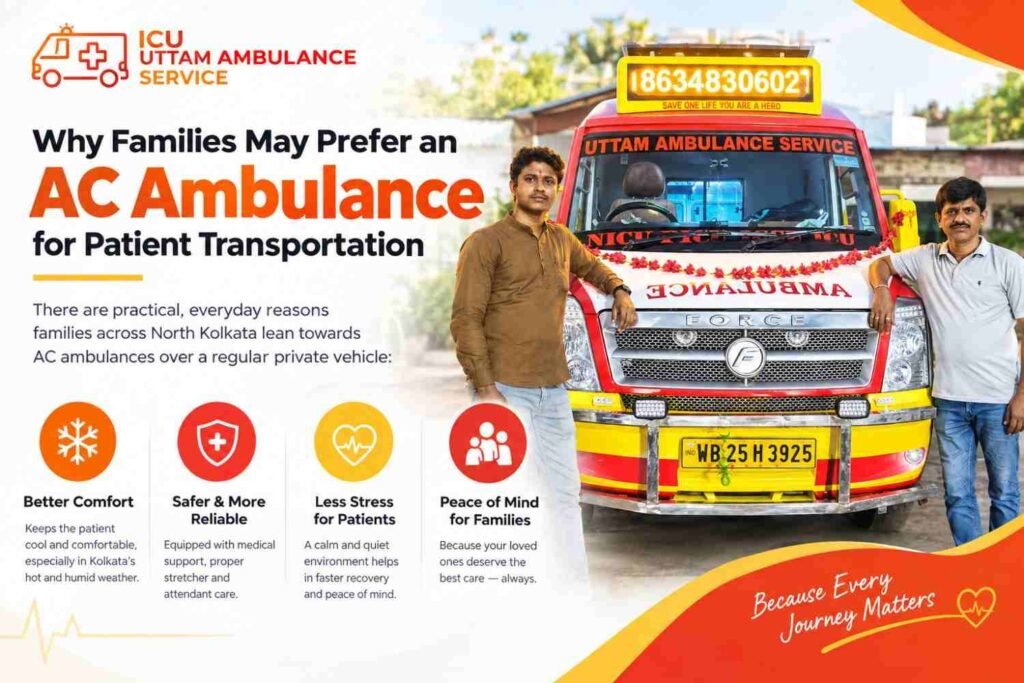
Why Families May Prefer an AC Ambulance for Patient Transportation
There are practical, everyday reasons families across North Kolkata lean towards AC ambulances over a regular private vehicle:
- A more comfortable environment during what can already be a difficult, tiring journey
- Genuinely useful during hot and humid weather, which is common for much of the year in Kolkata
- Better suited to longer journeys, where a controlled environment matters more over time
- Allows the patient to remain on a stretcher when their condition requires it
- More suitable than a regular private car for patients who are frail, in pain, or need to travel lying flat
That said, it’s worth repeating: air conditioning improves comfort, not medical capability. For patients who need active medical support during transit, the right ambulance category matters more than climate control alone.
Frequently Asked Questions:
1) Is AC ambulance service available in North Kolkata?
AC ambulance transportation is generally arranged for areas across North Kolkata, including Sinthi, Dumdum, Birati, Shyambazar, Maniktala, Kankurgachi, Laketown, Cossipore, Baranagar, Belgachia, Patipukur, and Sovabazar. Since actual real-time availability can depend on the provider and the time of your request, it’s best to confirm directly when you need transportation.
2) Can I book an AC ambulance from Dumdum to a hospital?
Yes, this kind of transportation can generally be arranged, depending on the provider’s availability and the specific requirements of the patient. It helps to share the exact pickup point in Dumdum and the destination hospital when booking.
3) Do AC ambulances provide oxygen?
This depends entirely on the specific ambulance and provider — not every AC ambulance carries oxygen equipment. If your patient may need oxygen during transport, confirm this directly with the provider before booking.
4) How much does an AC ambulance cost in North Kolkata?
Cost depends on several factors, including distance, ambulance type, time of day, and whether medical staff or equipment is required. Rather than a fixed rate, it’s best to request a direct quote based on your pickup and destination.
5) How quickly can an AC ambulance arrive?
Arrival time depends on your location, current traffic conditions, ambulance availability, and the time of day. For planned transportation, booking in advance is the best way to avoid delays.
6) Is an AC ambulance suitable for ICU patients?
Not necessarily. Air conditioning does not mean a vehicle is ICU-equipped. A critically ill patient who needs continuous monitoring or advanced life support typically requires an ICU or advanced life-support ambulance, not a standard AC ambulance.
7) Can a family member travel with the patient in the AC ambulance?
In most cases, yes — providers typically allow at least one attendant to accompany the patient. If you have more than one family member who needs to travel along, it’s worth confirming seating capacity with the provider at the time of booking.
Book an AC Ambulance Service in North Kolkata
Whether you’re in Sinthi, Dumdum, near the Airport, Birati, Shyambazar, Maniktala, Kankurgachi, Laketown, Cossipore, Baranagar, Belgachia, Patipukur, or Sovabazar, arranging appropriate patient transportation doesn’t need to be complicated — as long as you know what information to share.
When you’re ready to book, have the following ready:
- The exact pickup location
- The destination (hospital, nursing home, residence, or airport)
- A clear description of the patient’s condition
- The ambulance type required
- Your preferred pickup time
Contact the ambulance service to check current availability in your area and receive a quote based on your specific pickup and destination details.




Leave a Reply