Author Archives: Uttam Ambulance

Dead Body Carrier in Kolkata – Reliable & Professional Dead Body Transportation Service

Losing a family member is an extremely difficult experience, and arranging transportation of the deceased can become an additional responsibility at a time when families are already under emotional pressure. A professional dead body carrier can help make this process more organized by providing suitable transportation between permitted pickup and destination locations.

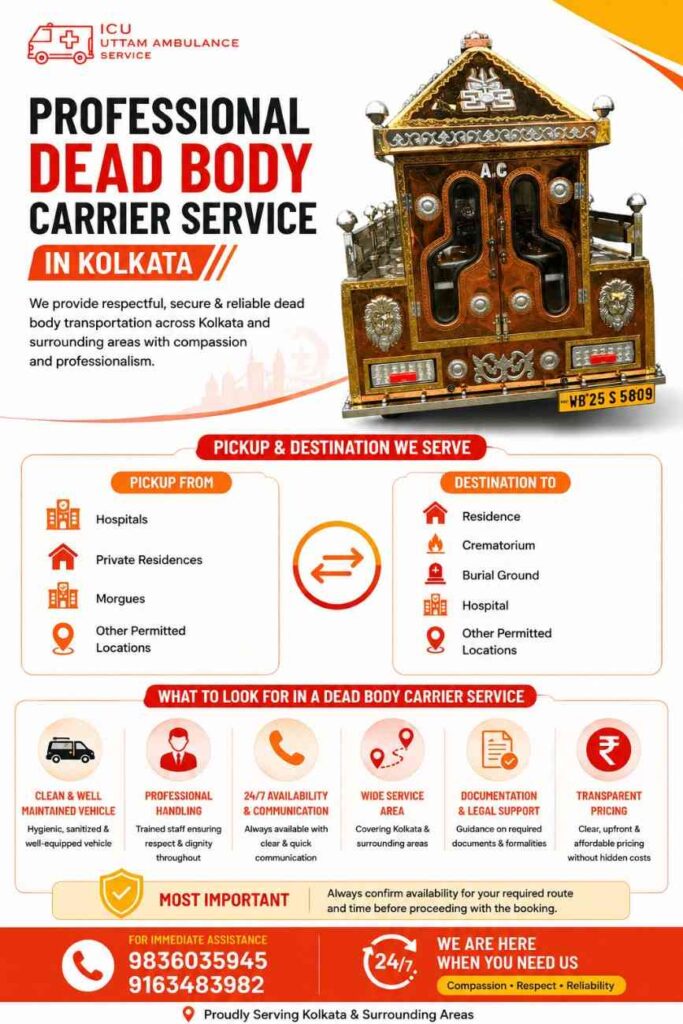
If you are looking for a dead body carrier in Kolkata, it is important to confirm the vehicle’s availability, pickup location, destination, required documents, estimated travel time, and total charges before making the booking. Depending on the circumstances, transportation may be required from a hospital, home, morgue, or another approved location to a crematorium, burial ground, residence, hospital, or other permitted destination.

A professional service should focus on respectful handling, safe transportation, suitable vehicle arrangements, cleanliness, and clear communication with the family. Exact availability and service coverage should always be confirmed with the provider before booking.

Professional Dead Body Carrier Service in Kolkata

A professional dead body transportation service is designed to help families arrange the movement of a deceased person in a respectful and secure manner. Rather than trying to organize unsuitable private transportation during an already stressful situation, families can contact a dedicated service provider and explain their pickup and destination requirements.

A suitable dead body carrier in Kolkata may be arranged for transportation from locations such as:

  • Hospitals
  • Private residences
  • Morgues
  • Other permitted pickup locations

The destination may include a residence, crematorium, burial ground, hospital, or another permitted location, depending on the circumstances and applicable requirements.

When choosing a service, families should look beyond simply finding an available vehicle. The condition and cleanliness of the vehicle, professional handling, communication, service area, documentation requirements, and pricing should all be considered.

Most importantly, the provider should clearly confirm whether transportation is available for the required route and time before the family proceeds with the booking.
Dead Body Transportation Service in Kolkata – How It Works

Arranging transportation of a deceased person does not have to be complicated, but having the correct information ready can make the process easier. The exact procedure can vary depending on the pickup location, destination, documentation, and provider.

Contact the Dead Body Carrier Service

The first step is to contact the service provider and explain the transportation requirement clearly.

Try to provide:

  • Pickup location and complete address
  • Destination and complete address
  • Preferred pickup date and approximate time
  • Whether the pickup is from a hospital, home, morgue, or another location
  • Required type of transportation
  • Any known documentation or destination requirements

Providing accurate information from the beginning helps the provider understand the journey and determine whether an appropriate vehicle is available.

Confirm Vehicle Availability

Once the pickup and destination details have been shared, confirm whether the required vehicle is available for the requested time.

For longer journeys, it is particularly important to discuss the route, approximate travel distance, expected timing, and any additional requirements before confirming the service.

Do not assume that a provider offers 24-hour, emergency, or outstation transportation unless the service has specifically confirmed it.

Prepare Required Documents

Documentation requirements can differ depending on where the deceased is being transported from, where they are going, and the circumstances involved.

Depending on the situation, the family may need medical or hospital documentation, identification, death-related documents, or other permissions.

Before arranging transportation, confirm the exact requirements with the relevant hospital, authorities, crematorium or burial facility, airline where applicable, and transportation provider.

Pickup and Transportation

After the booking and required arrangements have been confirmed, the carrier can proceed to the agreed pickup location.

The transportation process should be handled with dignity, care, and appropriate security. Families should also ensure that the pickup address and contact details provided to the service are accurate so that unnecessary delays can be avoided.

Safe Arrival at the Destination

The carrier transports the deceased to the confirmed destination according to the agreed arrangement.

The family should ensure that the receiving location is prepared and that any required permissions or documentation have been arranged in advance. This is particularly important when the destination is a crematorium, burial facility, hospital, or another institution with its own procedures.

Dead Body Carrier Available Across Kolkata and Nearby Areas

Families searching for a dead body carrier in Kolkata may need transportation from different parts of the city or nearby areas. Because pickup and destination requirements can vary significantly, always provide the exact location when contacting a service provider.

Instead of relying only on a broad Kolkata service-area claim, confirm whether the provider can reach your specific locality and whether the required route is available at your preferred time.

Dead Body Carrier in North Kolkata

Families looking for a Dead Body Carrier in Sinthi, Dead Body Carrier in Dumdum, or Dead Body Carrier in Airport may require transportation from a residence, hospital, morgue, or another permitted location.

Service requirements can also arise in areas such as Birati, Sodepur, Barrackpore, Shyambazar, Cossipore, Baranagar, Belgachia, Patipukur, and Sovabazar.

If you need a dead body carrier in these areas, provide the complete pickup address and destination when making an enquiry. This allows the provider to check route feasibility, vehicle availability, and the expected travel requirements.

Dead Body Carrier in Salt Lake, Bidhannagar, Rajarhat & New Town

Transportation may also be required from Salt Lake, Bidhannagar, Rajarhat, New Town, and surrounding areas.

Families searching for a Dead Body Carrier in Baguihati, Dead Body Carrier in Rajarhat, Dead Body Carrier in Salt Lake, or Dead Body Carrier in New Town should clearly communicate both the pickup and destination addresses.

Nearby areas such as Kestopur and Laketown may also require transportation arrangements. Because locations can cover different routes and distances, confirming the exact address before booking is important.

Dead Body Carrier in Central Kolkata

Central Kolkata includes busy and highly connected areas where accurate pickup coordination can be especially useful.

Transportation enquiries may come from areas such as Maniktala, Kakurgachi, Burrabazar, Moulali, Park Street, and Park Circus.

If you are arranging a Dead Body Carrier in Maniktala, Dead Body Carrier in Kakurgachi, or another central Kolkata locality, provide a clear landmark along with the complete address whenever possible. This can help the driver locate the pickup point more efficiently.

Dead Body Carrier in Howrah & Hooghly

Families may also need dead body transportation between Kolkata and locations across Howrah and Hooghly.

Relevant areas include:

  • Howrah
  • Dankuni
  • Uttarpara
  • Konnagar
  • Rishra
  • Serampore
  • Chandannagar
  • Chinsurah
  • Bandel
  • Mogra

If you are searching for a Dead Body Carrier in Howrah, Dead Body Carrier in Dankuni, or transportation toward Hooghly-side locations, confirm the complete route before booking.

For longer journeys, ask about the total estimated distance, travel time, vehicle availability, and applicable charges. Outstation transportation should only be assumed when the provider confirms that this service is available.

Dead Body Carrier in South & Southeast Kolkata

Transportation requirements can also arise in Mukundapur, Anandapur, Uluberia, Bagnan, and Seakhala.

When arranging transportation from these areas, the exact pickup and destination addresses are particularly important. A provider can use these details to determine whether the requested route falls within its service area and what transportation arrangement is appropriate.

Dead Body Carrier in Barasat, Madhyamgram, Kalyani & Nearby Areas

Families may also search for transportation services in Madhyamgram, Barasat, Kalyani, and nearby areas, as well as locations such as Singur.

If you need a Dead Body Carrier in Barasat, Dead Body Carrier in Madhyamgram, or another location outside central Kolkata, confirm the distance and route before finalizing the booking.

For transportation over a longer distance, ask the provider to explain the expected timing and complete cost so that there are no avoidable surprises later.

Types of Dead Body Transportation Services

The transportation requirement can differ from one family to another. The most appropriate arrangement depends on the pickup point, destination, documentation, and circumstances.

Hospital to Home Transportation

After a death in a hospital, a family may need to arrange transportation to the deceased’s residence. Before arranging the carrier, confirm the hospital’s release procedure and any documents that must be completed.

Once the hospital has authorized the release, provide the transportation provider with the exact hospital location and home address.

Hospital to Crematorium or Burial Ground

Families may need transportation directly from a hospital to a crematorium or burial facility.

In this situation, it is important to coordinate with both the hospital and the destination facility. Confirm that the necessary documentation and permissions are in place before the vehicle arrives.

Home to Crematorium or Burial Ground

When a death occurs at home, transportation may be required from the residence to the appropriate cremation or burial location.

The family should first confirm any applicable medical, legal, or local requirements and then provide the carrier with accurate pickup and destination details.

Morgue to Destination Transportation

Transportation may also be required from a morgue or other approved facility.

Because release procedures can vary between facilities, confirm the required documentation and timing with the relevant authority before arranging the carrier.

Long-Distance or Outstation Dead Body Transportation

Some families may need to transport the deceased beyond Kolkata or to another district or state.

This should only be arranged if the service provider actually offers long-distance or outstation transportation. Before confirming, discuss the route, distance, estimated journey time, vehicle availability, documents, and total charges.

Why Choose a Professional Dead Body Carrier in Kolkata?

During a bereavement, families should not have to spend unnecessary time trying to organize unsuitable transportation. A professional service can help make the transportation process more structured.

Respectful Handling

Transportation of a deceased person requires sensitivity and dignity. Families should choose a provider that understands the seriousness of the situation and handles the deceased respectfully throughout the journey.

Suitable Transportation Vehicle

A dedicated dead body carrier is designed for this specific transportation requirement. Choosing a suitable vehicle can make the journey more appropriate and manageable than attempting to arrange ordinary private transportation.

Hygienic and Secure Transportation

Vehicle cleanliness and appropriate transportation conditions are important considerations. Before booking, families can ask the provider about the vehicle condition and how the transportation is handled.

Convenient Pickup and Drop Coordination

Accurate addresses, contact information, and timing can make coordination easier. This becomes particularly important when transportation involves hospitals, busy city areas, or longer routes.

Support During a Difficult Time

A professional transportation provider should communicate clearly and help the family understand what information is required to arrange the service.

The goal is not simply to provide a vehicle. It is to make an already difficult logistical responsibility as straightforward as possible.

How to Choose a Reliable Dead Body Carrier Service in Kolkata

When comparing a professional dead body carrier in Kolkata, do not make the decision based only on the lowest quoted price. A few practical checks can help you choose a service that matches your actual requirement.

Consider the following:

  • Availability: Confirm that the vehicle is available for your required date and time.
  • Service area: Check whether the exact pickup and destination are covered.
  • Vehicle condition: Ask whether the vehicle is appropriate, clean, and properly maintained.
  • Professional handling: Look for a provider that treats the deceased and family with dignity.
  • Transparent pricing: Ask what is included in the quoted amount.
  • Route coordination: Provide complete pickup and destination details.
  • Documentation: Confirm what documents are required before pickup.
  • Long-distance service: If needed, specifically confirm whether outstation transportation is offered.
  • Customer support: Make sure you can reach the provider for booking and coordination.
  • Booking confirmation: Confirm the vehicle, timing, pickup point, destination, and agreed charges before dispatch.

A reliable dead body transportation service in Kolkata should give the family clear information instead of leaving important details uncertain.

What Information Should You Provide When Booking a Dead Body Carrier?

When contacting a dead body carrier, having the necessary details ready can make the booking process faster and reduce misunderstandings.

Provide:

  • Name and contact number of the person arranging the transportation
  • Complete pickup address
  • Complete destination address
  • Preferred pickup date and time
  • Hospital, home, morgue, or other pickup details
  • Approximate travel distance, if known
  • Required transportation type
  • Any known documentation requirements

If the pickup is from a hospital or morgue, mention the facility name and any relevant department or contact information you have.

If the destination is a crematorium or burial ground, provide its exact name and location.

The more accurate the information, the easier it is for the provider to confirm whether the required vehicle and route are available and provide an appropriate quotation.

Dead Body Carrier Charges in Kolkata

There is no single price that applies to every dead body transportation requirement. The final charge can depend on several practical factors related to the journey.

These may include:

  • Pickup location
  • Destination
  • Total distance
  • Local or outstation transportation
  • Vehicle type
  • Pickup timing
  • Waiting time, where applicable
  • Additional services requested
  • Special transportation requirements

For example, a short-distance local journey may have different charges from a longer trip outside Kolkata. Similarly, additional requirements can affect the total cost.

Before confirming the booking, ask the provider for the total estimated cost and clarify what is included. If there are possible additional charges, ask about them in advance.

Clear pricing is particularly important during a stressful situation because it allows the family to make arrangements without unnecessary uncertainty.

Documents Required for Dead Body Transportation

The documents required for transporting a deceased person can vary according to the circumstances, pickup location, destination, and applicable rules.

Depending on the situation, families may need documents such as:

  • Death certificate or death declaration
  • Hospital or medical documentation
  • Identification documents
  • Permissions or other documents required by the relevant authority or destination

The exact requirements should not be assumed. A hospital may have its own release procedure, while a crematorium, burial facility, airline, or authority may have additional requirements.

Before arranging transportation, confirm the required documents with the relevant hospital, local authorities, crematorium or burial facility, airline where applicable, and the transportation provider.

Having the necessary paperwork ready can help prevent avoidable delays during pickup or arrival.

Frequently Asked Questions About Dead Body Carrier in Kolkata

How can I book a dead body carrier in Kolkata?

Contact the service provider and provide the pickup location, destination, preferred date and time, and transportation requirements. The provider can then confirm vehicle availability, service coverage, required documents, and estimated charges.

Is a dead body carrier available in North Kolkata?

Transportation requirements can arise across North Kolkata, including Sinthi, Dumdum, Airport, Birati, Sodepur, Barrackpore, Shyambazar, Cossipore, Baranagar, Belgachia, Patipukur, and Sovabazar. Exact availability should be confirmed with the service provider for your required route and time.

Do you provide dead body carrier service from Kolkata to nearby districts?

This depends on the provider’s actual service area. If you require transportation outside Kolkata, provide the complete pickup and destination addresses and specifically confirm whether outstation transportation is available.

Can a dead body carrier pick up the deceased from a hospital?

Transportation from a hospital may be possible, but the hospital’s release procedures and required documentation must be followed. Confirm with the hospital and transportation provider before arranging pickup.

Can the deceased be transported from home?

Transportation from a residence may be possible depending on the circumstances and applicable requirements. Families should confirm any required medical, legal, or local procedures before arranging the carrier.

How much does a dead body carrier cost in Kolkata?

Charges vary according to factors such as distance, pickup and destination, vehicle type, timing, local or outstation travel, waiting time, and additional requirements. Ask the provider for a complete estimated cost before confirming the booking.

Is dead body transportation available at night?

Night or 24-hour transportation should not be assumed. Availability depends on the individual service provider. If transportation is required at night, specifically confirm the operating hours and vehicle availability before booking.

What documents are required?

Requirements can vary. Depending on the situation, families may need death-related documentation, hospital or medical records, identification, and other permissions. Confirm the exact requirements with the relevant hospital, authority, destination facility, and transportation provider.

Do you provide transportation outside Kolkata?

Outstation transportation depends on the provider’s service coverage. If you need to travel outside Kolkata, provide the complete route and ask the provider to confirm availability, timing, documents, and charges.

Book a Dead Body Carrier in Kolkata

If you need a reliable dead body carrier in Kolkata, the first step is to provide the service provider with accurate pickup and destination details.

When contacting the provider, keep the following information ready:

  • Pickup location
  • Destination
  • Preferred date and time
  • Hospital, home, or morgue details
  • Contact number
  • Transportation requirements
  • Any available documentation

The provider can then confirm whether a suitable vehicle is available, explain the booking process, and provide the applicable estimated charges.

For families dealing with a loss, clear communication and respectful transportation matter. Take a moment to confirm the vehicle, route, timing, documents, and total estimated cost before finalizing the arrangement.


ICU Ambulance Cost in Kolkata — Factors That Affect Pricing

When a patient needs critical care transportation, one of the first concerns for the family is often the ICU ambulance cost in Kolkata. However, there is no single price that applies to every ICU ambulance journey. The final cost can depend on several factors, including the patient’s medical requirements, travel distance, equipment needed, medical support, journey duration, and any additional services required during transportation.

For families arranging an urgent hospital transfer, understanding these factors can make it easier to request an accurate quotation and avoid unexpected charges. It is also important to look beyond the basic fare and confirm whether the ambulance is properly equipped for the patient’s transportation needs.

How Much Does an ICU Ambulance Cost in Kolkata?

The cost of an ICU ambulance in Kolkata can vary from one journey to another. A short hospital transfer within Kolkata may have different requirements from a long distance transfer to another city. Similarly, a patient who requires a higher level of medical support during transportation may need a different ambulance setup than a patient with more stable requirements.

Instead of relying on a general price, families should request a quotation based on the actual journey and patient care requirements.

The quotation may depend on:

  • Pickup and destination locations
  • Total travel distance
  • Patient’s condition and transportation requirements
  • Medical equipment required
  • Medical staff or trained attendant requirements
  • Expected journey duration
  • Waiting time
  • Additional stops or route requirements
  • Long distance or intercity transportation needs

If you are comparing ICU ambulance charges in Kolkata, ask the provider what is included in the quoted fare before making a booking. This gives you a clearer understanding of the actual transportation cost.

Why Does ICU Ambulance Pricing Vary in Kolkata?

ICU ambulance pricing can differ because every patient transfer is not the same. Two patients may travel a similar distance but still require different levels of medical support.

For example, one patient may need only transportation with basic monitoring, while another may require more extensive critical care equipment and medical supervision. The ambulance provider may also need to account for journey duration, waiting requirements, or a longer route.

Therefore, the ICU ambulance price in Kolkata should be considered in relation to the complete transportation requirement rather than as a single standard figure.

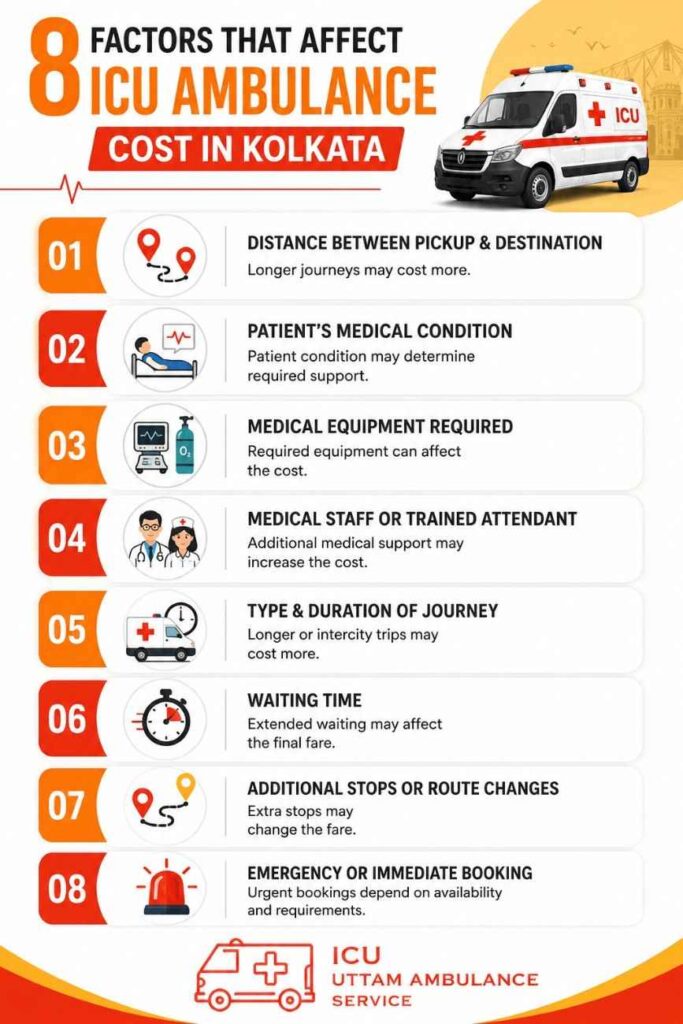
8 Factors That Affect ICU Ambulance Cost in Kolkata

1. Distance Between Pickup and Destination

Distance is one of the most obvious factors that can affect ambulance pricing. A transfer over a short distance within Kolkata may have different transportation requirements from a longer journey.

The quotation can vary depending on whether the patient is travelling:

  • From home to a nearby hospital
  • From one hospital to another within Kolkata
  • Across a longer route within or around the city
  • From Kolkata to another city

The total journey distance and travel duration should therefore be discussed with the ambulance provider before booking.

2. Patient’s Medical Condition

The patient’s condition is another important consideration when arranging critical care transportation.

A critically ill patient may require closer observation, medical monitoring, or additional support during the journey. This can influence the type of ambulance and level of care required.

Families should provide the ambulance provider with accurate information about the patient’s current transportation needs. This helps the provider determine whether the available ambulance setup is suitable for the journey.

The goal should not simply be to find the lowest ambulance cost in Kolkata, but to arrange transportation that matches the patient’s requirements.

3. Medical Equipment Required During Transportation

An ICU ambulance may need to provide specific medical equipment depending on the patient’s needs. The equipment required during transportation can therefore influence the overall quotation.

Depending on the ambulance provider and patient’s requirements, this may involve equipment such as:

  • Patient monitoring equipment
  • Oxygen support
  • Ventilator support
  • Cardiac monitoring
  • Other critical care equipment

Not every ambulance has the same equipment or configuration. Before booking, ask the provider whether the required equipment is available and whether it is included in the quoted price.

4. Medical Staff or Trained Attendant Requirement

Some patients may need medical supervision or trained assistance during transportation. If additional medical personnel are required, this can affect the overall service cost.

It is useful to distinguish between the ambulance itself and the level of medical support provided during the journey.

Before booking, families should clarify:

  • Whether trained medical personnel are available
  • What type of support can be provided during transportation
  • Whether the staff requirement is included in the quotation
  • Whether any additional personnel charges apply

Only the medical support actually required for the patient should be arranged.

5. Type and Duration of the Journey

The type and length of the transfer can also influence ICU ambulance cost in Kolkata.

A short one way hospital transfer is different from a journey that takes several hours or involves travel outside Kolkata. Longer journeys may require additional planning and resources.

The provider may need to consider:

  • One way transportation
  • Long distance transfers
  • Intercity patient transfers
  • Extended travel duration
  • Route specific requirements

For a long distance transfer, it is particularly important to discuss the complete fare and any applicable additional charges before the journey begins.

6. Waiting Time

Sometimes the ambulance may need to wait because of delays at the pickup hospital, admission procedures, discharge formalities, or other circumstances.

For example, a patient may be ready for transfer but require additional time before leaving the hospital. Similarly, an ambulance may need to wait at the destination during the transfer process.

Whether waiting charges apply depends on the ambulance provider’s pricing policy. Ask about waiting time in advance so you understand how it may affect the final quotation.

7. Additional Stops or Route Requirements

The requested route can also affect the final cost. If a family requests an additional stop, changes the destination, or needs another pickup or drop off point, the transportation requirements may change.

These details are best discussed before the ambulance starts the journey.

Providing the complete route at the time of booking can help the provider give a more accurate quotation.

8. Emergency or Immediate Booking Requirements

Some patient transfers need to be arranged immediately, while others can be planned in advance. An urgent transfer may require the ambulance provider to coordinate resources quickly based on availability and the patient’s requirements.

However, it should not be assumed that every emergency booking automatically carries an additional charge. Pricing depends on the provider’s actual policy and the specific requirements of the journey.

When possible, ask for the applicable fare and included services before confirming the booking.

What Is Usually Included in an ICU Ambulance Cost?

The services included in an ICU ambulance quotation can vary between providers and according to the patient’s requirements.

Depending on the service, the quoted amount may relate to:

  • Ambulance transportation
  • Medical equipment
  • Oxygen support
  • Patient monitoring
  • Medical personnel or trained attendants
  • Pickup and drop off
  • Other critical care transportation support

Do not assume that every item is automatically included in the basic fare.

Before confirming an ambulance, ask the provider to explain exactly what the quoted amount covers. This is particularly important when comparing ICU ambulance charges in Kolkata, because a lower initial quotation may not represent the same level of service as another provider’s quotation.

Are There Additional Charges for an ICU Ambulance in Kolkata?

Additional charges may apply depending on the journey and the ambulance provider’s terms.

Potential factors can include:

  • Extra waiting time
  • Additional distance
  • Additional stops
  • Special medical equipment
  • Additional medical personnel
  • Long distance or intercity transportation

These charges are not necessarily applicable to every booking. The best approach is to discuss them before confirming the ambulance.

Ask for a complete quotation and clarify whether it includes the expected journey, required equipment, medical support, and any other services your patient needs.

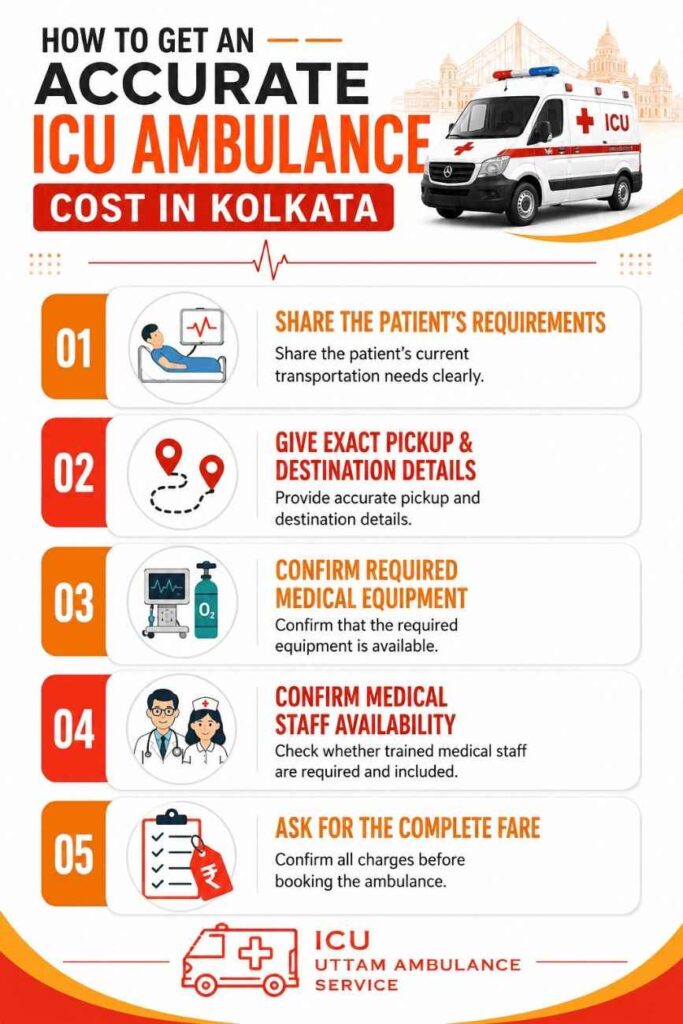
How to Get an Accurate ICU Ambulance Cost in Kolkata

Getting an accurate quotation becomes easier when you provide the ambulance provider with complete information.

Share the Patient’s Current Requirements

Tell the provider about the patient’s current transportation needs as clearly as possible. Relevant information can help the provider understand what type of ambulance and support may be appropriate.

Avoid withholding important information simply to obtain a lower initial quotation. The priority should be appropriate patient transportation.

Give Exact Pickup and Destination Details

Provide the exact pickup location and destination. If the patient is being transferred between hospitals, share the names and locations of both facilities.

Accurate location details help the provider assess the journey distance and route requirements.

Ask What Medical Equipment Is Needed

If the patient requires specific medical support, ask whether the ambulance has the appropriate equipment.

For example, if oxygen or ventilator support is required, confirm availability before booking rather than assuming that every ICU ambulance has identical equipment.

Confirm Medical Staff Availability

If the patient’s condition requires medical supervision during transportation, confirm what type of trained personnel can accompany the patient.

Also ask whether the personnel requirement is already included in the quotation or involves an additional charge.

Ask for the Complete Fare Before Booking

Before confirming the ambulance, ask for clarity on:

  • Base fare
  • Included services
  • Medical equipment
  • Medical staff
  • Waiting charges
  • Additional distance charges
  • Additional stops
  • Long distance charges, where applicable

This makes it easier to understand the actual ICU ambulance charges in Kolkata before the journey begins.

Questions to Ask Before Booking an ICU Ambulance

When arranging critical care transportation, a short checklist can prevent confusion later.

Ask the ambulance provider:

  1. What is the total ICU ambulance cost for this journey?
  2. What services are included in the quoted amount?
  3. Is the required medical equipment available?
  4. Is oxygen or ventilator support available if required?
  5. Is trained medical staff available when needed?
  6. Are waiting charges applicable?
  7. Are additional distance or route charges applicable?
  8. Does the quotation cover the complete journey?
  9. How soon can the ambulance reach the pickup location?

These questions can help families compare quotations based on the actual service being provided rather than price alone.

How to Choose an ICU Ambulance Service in Kolkata Without Focusing Only on Price

Price is important when arranging an ambulance, but it should not be the only consideration when a patient needs critical care transportation.

An ambulance that is suitable for one patient may not necessarily be suitable for another. Before making a decision, consider:

  • Required medical equipment
  • Patient care capabilities
  • Availability of trained personnel
  • Ambulance availability
  • Expected response time
  • Pricing transparency
  • Communication from the provider
  • Suitability for the patient’s transportation requirements

If you are considering Uttam Ambulance, discuss the patient’s requirements and journey details with the service provider before booking. This allows you to understand what type of support is available and request a quotation based on the actual transfer.

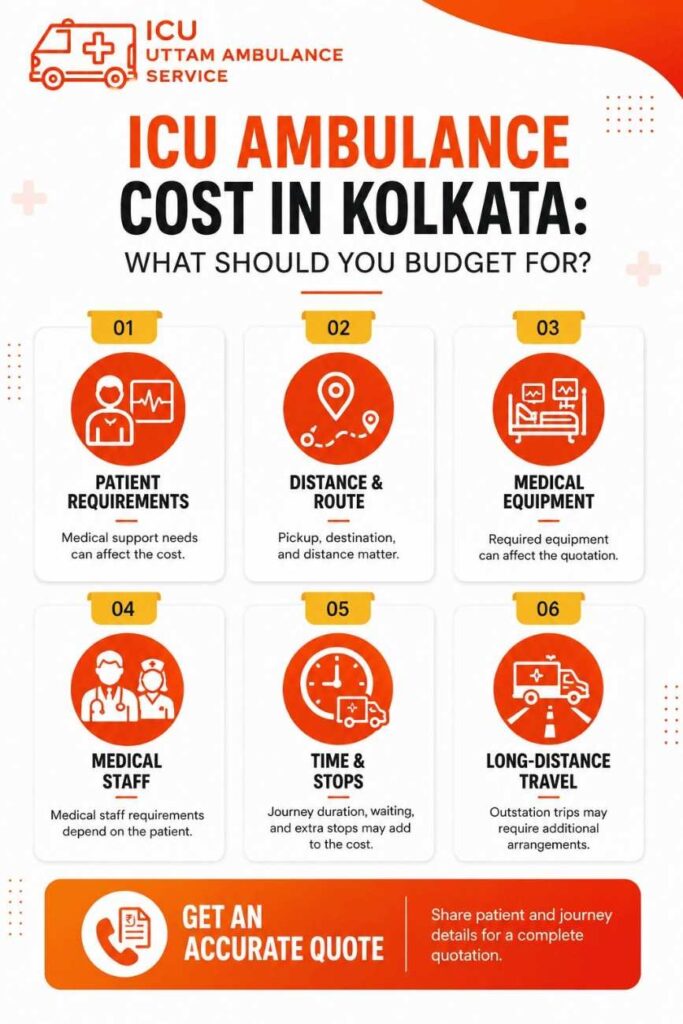
ICU Ambulance Cost in Kolkata: What Should You Budget For?

When planning for an ICU ambulance, think about the complete transportation requirement, not just a basic ambulance fare.

The final quotation may depend on:

  • Distance
  • Medical support
  • Equipment
  • Medical staff
  • Journey duration
  • Waiting time
  • Additional stops
  • Long distance transportation
  • Other journey specific requirements

There is no need to rely on an arbitrary standard figure when the actual cost can be discussed according to the patient’s needs and travel details.

For families searching for ICU ambulance cost in Kolkata, the most practical step is to provide accurate patient and journey information and ask the provider for a complete quotation before confirming the booking.

Frequently Asked Questions About ICU Ambulance Cost in Kolkata

How much does an ICU ambulance cost in Kolkata?

The cost varies depending on factors such as travel distance, patient care requirements, medical equipment, medical staff, journey duration, waiting time, and other transportation needs. For an accurate quotation, provide the ambulance provider with the complete journey and patient requirements.

What factors affect ICU ambulance charges in Kolkata?

Common factors include pickup and destination distance, patient condition, medical equipment, medical personnel, journey duration, waiting time, additional stops, and long distance transportation requirements.

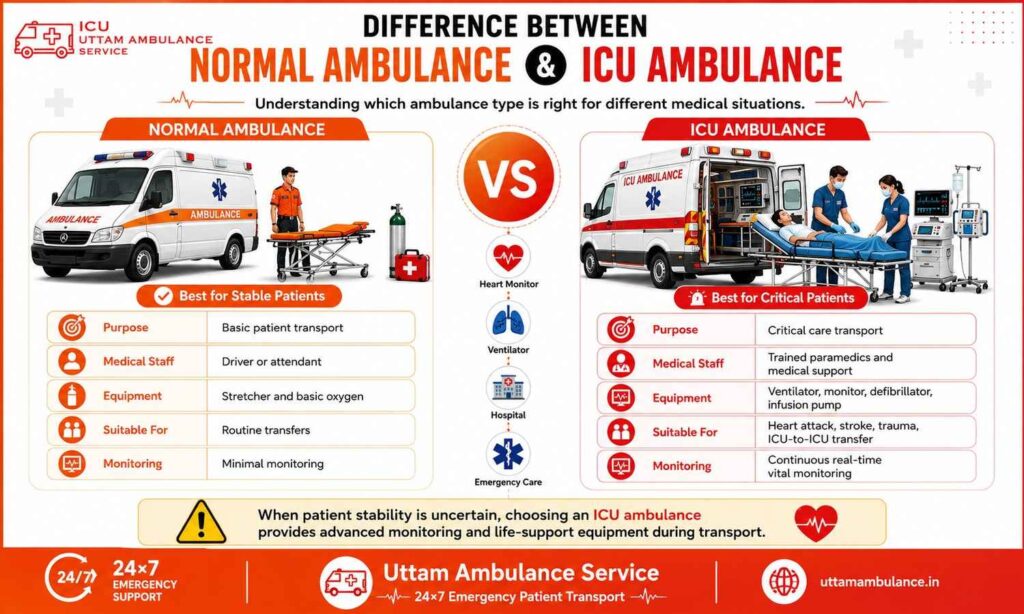
Is ICU ambulance more expensive than a regular ambulance?

An ICU ambulance may cost more because it can involve a higher level of medical support, equipment, monitoring, and patient care requirements. The actual difference depends on the services and equipment required for the particular journey.

Does the ICU ambulance fare include medical equipment?

That depends on the ambulance provider, the equipment required, and the quotation provided for the journey. Always confirm which equipment is included before booking.

Are oxygen and ventilator support included in ICU ambulance charges?

This depends on the ambulance’s available equipment and the patient’s requirements. If oxygen or ventilator support is needed, confirm availability and whether it is included in the quoted fare before booking.

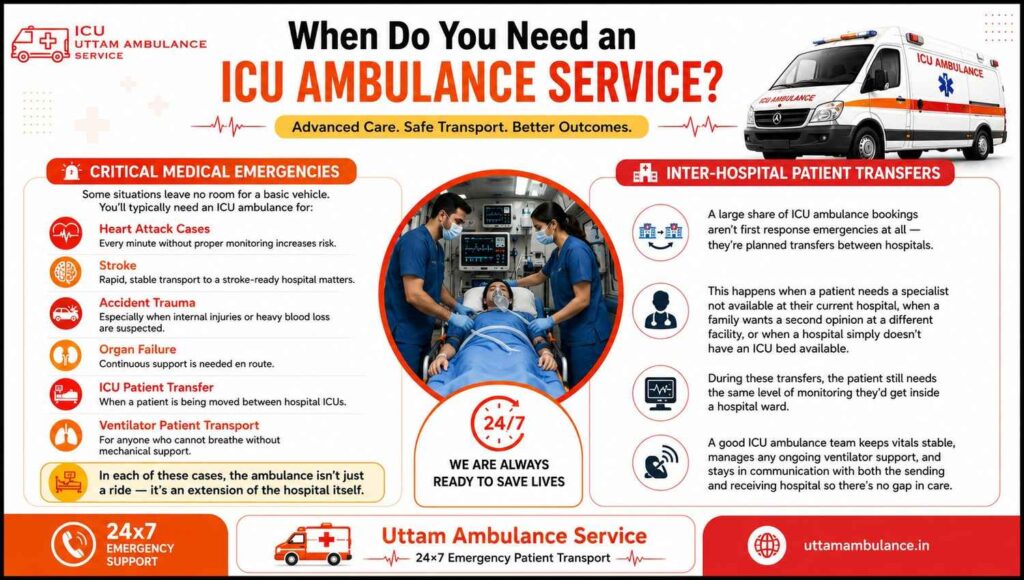
Can ICU ambulances be used for hospital to hospital transfers in Kolkata?

Yes, ICU ambulances can be arranged for patient transfers between hospitals when the required ambulance and medical support are available. Share the pickup and destination details with the provider so the appropriate transportation can be arranged.

Do waiting charges apply to ICU ambulance services?

Waiting charges may apply depending on the ambulance provider’s policy and the duration of the wait. Ask about waiting charges before confirming the booking, particularly when hospital discharge or admission may take time.

Does distance affect ICU ambulance cost in Kolkata?

Yes. The distance between the pickup and destination locations, along with the journey duration and route, can influence the overall quotation. Long distance or intercity transfers may have different pricing from shorter local journeys.

How can I get an accurate ICU ambulance price in Kolkata?

Provide the ambulance provider with the patient’s transportation requirements, exact pickup and destination locations, required medical equipment or support, and journey details. Then ask for a complete quotation that clearly explains included and additional charges.

What should I check before booking an ICU ambulance?

Check whether the ambulance is appropriate for the patient’s requirements, whether the required medical equipment and trained personnel are available, what services are included, whether waiting or additional charges apply, and what the total quotation covers.

Conclusion

The ICU ambulance cost in Kolkata is not determined by one universal fixed rate. The final quotation can vary according to the patient’s transportation requirements, distance, medical equipment, medical support, staff requirements, journey duration, waiting time, and other factors related to the transfer.

For families arranging critical care transportation, the best approach is to explain the patient’s requirements clearly, provide accurate pickup and destination details, and ask for a complete quotation before confirming the ambulance. Price matters, but the ambulance should also be suitable for the level of support the patient needs during transportation.

If you are arranging an ICU ambulance in Kolkata through Uttam Ambulance, discuss the patient’s requirements and journey details with the provider to understand the available service and obtain an accurate quotation.

Best PICU Ambulance in Kolkata — What Makes a Pediatric Ambulance Reliable?

When a child faces a serious illness or injury, getting immediate medical support becomes the top priority. However, when a critically ill child needs to be transferred between hospitals, from home to the ICU, or for specialized treatment, a regular ambulance may not provide the required level of care. A PICU ambulance in Kolkata offers advanced pediatric emergency transport with continuous monitoring, specialized medical equipment, and trained healthcare professionals experienced in handling critical child patients.

Pediatric emergencies require specialized attention because children respond differently to illness, trauma, and medication compared to adults. Their smaller airways, changing vital signs, and unique medical needs make safe transportation more complex. Choosing the right pediatric ambulance service in Kolkata is not only a transportation decision but an important medical decision.

For parents and caregivers, arranging emergency child transportation can be stressful due to concerns about safety, medical support, and the overall transfer process. This guide explains what a PICU ambulance is, why pediatric critical care transport is important, what makes an ambulance service reliable, and the key factors to consider before booking.

A PICU ambulance is more than a vehicle — it functions as a mobile critical care unit equipped to support children who require continuous monitoring and emergency medical assistance during transfer. Understanding its features can help families make a safer and more informed choice during critical situations.

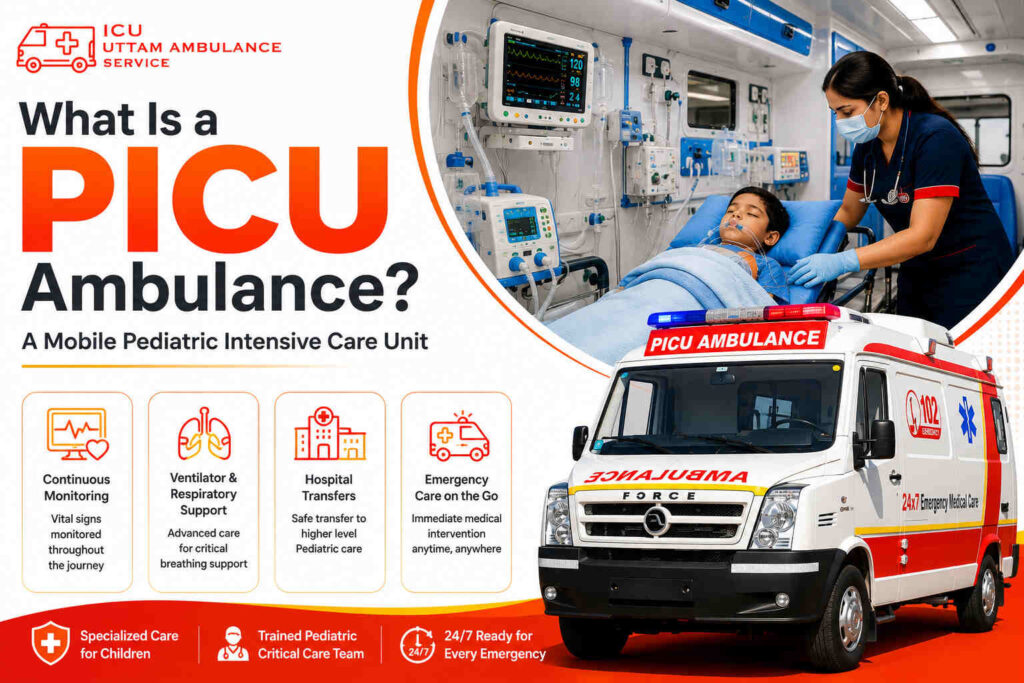
What Is a PICU Ambulance?

PICU stands for Pediatric Intensive Care Unit. A PICU ambulance, then, is essentially a mobile extension of that unit — a specially equipped ambulance built to safely transport children who require intensive, continuous medical care during the journey.

Unlike a standard ambulance, which is generally equipped to handle general emergencies and basic first aid, a PICU ambulance is designed around the specific needs of critically ill children. This includes children who:

  • Need continuous monitoring of vital signs like heart rate, oxygen saturation, and blood pressure
  • Require ventilator or respiratory support
  • Are being transferred between hospitals for a higher level of critical care
  • Need emergency medical intervention that can’t wait until they reach the hospital

The key difference between a regular ambulance and a PICU ambulance comes down to two things: equipment and expertise. A regular ambulance can move a patient from point A to point B safely for non critical situations. A PICU ambulance is built to sustain intensive care itself, on the move — meaning the level of monitoring and support a child receives doesn’t pause just because they’re in transit.

Pediatric patients also require a different approach to care simply because of their age and physiology. Dosages, equipment sizing, and even the way vital signs are interpreted differ significantly between children and adults. A PICU ambulance and its team are equipped to handle these differences correctly, which is something a general ambulance setup usually isn’t designed for.

Why Do Children Need a Specialized PICU Ambulance?

Not every child who needs to go to the hospital needs a PICU ambulance. But there are specific situations where this level of specialized transport becomes medically necessary rather than optional.

Some common situations where a PICU ambulance may be required include:

  • Critical illness — conditions like severe sepsis, organ dysfunction, or other life threatening illnesses that require constant medical supervision
  • Breathing difficulties — children experiencing respiratory distress who need oxygen support or airway management during the move
  • Ventilator dependency — children who are already on a ventilator and need to be moved without any interruption in respiratory support
  • Serious infections — cases where a child’s condition could deteriorate quickly and needs to be watched closely en route
  • Trauma cases — accidents or injuries where internal monitoring and rapid intervention capability are essential
  • Hospital to hospital ICU transfers — when a child needs to be moved to a facility with more specialized pediatric critical care resources

In each of these situations, the goal of a PICU ambulance is the same: to make sure that the level of care a child is receiving in the hospital doesn’t drop, even for the duration of the journey. It’s less about the distance being covered and more about the continuity of critical care throughout that distance.

What Makes a PICU Ambulance Reliable?

This is really the core question every parent or caregiver should be asking before booking a service. A PICU ambulance can only be called “reliable” when several things come together correctly — the equipment, the people operating it, the monitoring process, and the ability to respond to the unexpected. Let’s break each of these down.

Advanced Medical Equipment and Monitoring Systems

The equipment on board a PICU ambulance isn’t just a checklist — each piece plays a specific role in keeping a child stable during transport.

  • Ventilator support — for children who cannot breathe adequately on their own, a transport ventilator maintains consistent respiratory support throughout the journey, matching the settings used in the hospital ICU.
  • Oxygen systems — portable oxygen delivery ensures oxygen levels remain stable, which is especially critical for children with respiratory or cardiac conditions.
  • Cardiac monitors — continuous ECG monitoring tracks heart rhythm and rate, allowing the medical team to catch any irregularities immediately.
  • Pulse oximeter — this tracks blood oxygen saturation in real time, giving the team an early warning if a child’s oxygen levels start to drop.
  • Infusion pumps — used to deliver fluids or medication at a precise, controlled rate, which is especially important for children where dosage accuracy matters more than in adults.
  • Emergency medication support — pediatric specific emergency medications on board mean the team can respond immediately if the child’s condition changes, without waiting to reach the hospital.

Each of these tools exists to answer one question during transport: is the child stable right now, and if not, what needs to happen immediately? Without this equipment, that question often can’t be answered in time.

Trained Medical Team and Pediatric Care Experience

Equipment alone doesn’t save lives — the people using it do. A PICU ambulance is only as reliable as the medical professionals on board.

  • Trained paramedics who understand pediatric emergency protocols, not just general emergency response
  • Emergency medical professionals experienced in recognizing early signs of a child’s condition worsening
  • Hands on experience with pediatric patients, including how to communicate with frightened children and anxious parents while still working efficiently

A skilled team knows how to read subtle changes in a child’s condition that equipment alone might not immediately flag. This combination of trained eyes and reliable machines is what actually keeps a child safe during transport — one without the other leaves gaps.

Continuous Monitoring During Transportation

One of the biggest misconceptions about ambulance transport is that monitoring is only necessary until the patient is loaded in — after that, it’s just a drive to the hospital. For a critically ill child, that assumption can be dangerous.

A reliable PICU ambulance maintains continuous monitoring of:

  • Vital signs throughout the entire journey, not just at pickup and drop off
  • Oxygen levels, since even brief drops can affect a child’s condition
  • Heart rate and rhythm, to catch any sudden changes early
  • Overall patient stability, adjusting care in real time if something shifts

This continuous approach means the ambulance isn’t just “moving” the child — it’s actively caring for them the entire way, exactly as they would be cared for inside a hospital ward.

Proper Emergency Response Capability

Even with the best planning, a child’s condition can change unexpectedly during transport. A reliable PICU ambulance service is prepared for exactly this.

This includes being ready for:

  • Sudden changes in the child’s condition, with the team trained to respond immediately rather than wait until arrival
  • On the spot medical intervention when needed, using the equipment and medication already on board
  • Ongoing communication with the receiving hospital’s team, so doctors are aware of the child’s status before they even arrive

This preparedness is what separates a transport service from a true critical care transport service.

PICU Ambulance vs Normal Ambulance — What Is the Difference?

Here’s a simple side by side look at how a PICU ambulance compares to a standard ambulance:


Factor Normal Ambulance PICU Ambulance
Patient Type General emergency cases Critically ill children
Monitoring Basic Advanced, continuous
Equipment Limited ICU level equipment
Medical Support Basic emergency care Critical care support
Team Training General emergency response Pediatric critical care trained


The core takeaway: a normal ambulance is built for transport, while a PICU ambulance is built to sustain intensive care during transport. For a critically ill child, that distinction can matter a great deal.

PICU Ambulance vs ICU Ambulance vs NICU Ambulance

These three terms are often used interchangeably, but each serves a different patient group. Understanding the difference helps ensure the right service is booked for the right situation.

  • PICU Ambulance — designed for critically ill children, generally beyond infancy through adolescence, who require intensive monitoring and care during transport.
  • ICU Ambulance — designed for adult critical care patients who need continuous monitoring, ventilator support, or advanced life support during transfer.
  • NICU Ambulance — designed specifically for newborns and premature babies, with specialized incubators and equipment sized and calibrated for very small patients.

Booking the correctly specialized ambulance matters because the equipment, training, and even the physical setup inside each of these vehicles is tailored to a specific patient group.

When Should You Consider Booking a PICU Ambulance in Kolkata?

There are a few clear scenarios where booking a PICU ambulance makes sense:

  • Your child’s doctor has specifically recommended critical care transport
  • Your child is being transferred to or from an ICU
  • Your child is ventilator dependent and needs to be moved
  • Your child requires continuous monitoring that can’t be paused during a routine ambulance ride
  • Your child needs to be transferred over a longer distance where medical support throughout the journey is essential

If any of these apply, it’s worth reaching out to a provider directly to discuss your child’s specific situation rather than assuming a standard ambulance will be sufficient.

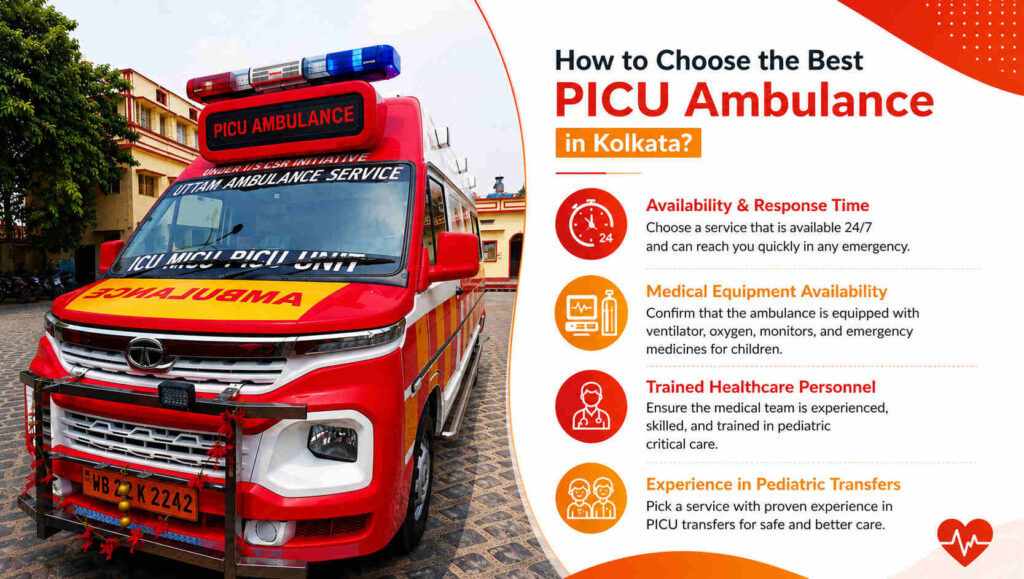
How to Choose the Best PICU Ambulance in Kolkata?

Choosing the right service under pressure is difficult, which is why it helps to know what to check for in advance. Here’s a practical checklist.

Availability and Response Time

In a pediatric emergency, minutes matter. Ask how quickly the ambulance can reach your location and whether the service operates 24/7. A provider that can respond quickly, any time of day or night, reduces the time your child spends waiting for the care they need.

Medical Equipment Availability

Before booking, confirm the ambulance is actually equipped with:

  • Ventilator
  • Oxygen support
  • Monitoring devices (cardiac monitor, pulse oximeter)
  • Emergency medicines suited for pediatric use

Don’t assume — ask directly, especially if your child has a specific medical need like ventilator dependency.

Trained Healthcare Personnel

It’s reasonable to ask questions like:

  • Does the medical team have specific experience with pediatric patients?
  • Who will be accompanying my child during transport?
  • What is their training background in emergency or critical care?

A trustworthy provider will answer these questions clearly and without hesitation.

Experience in Pediatric Transfers

General ambulance experience isn’t the same as pediatric transfer experience. Ask how often the provider handles PICU transfers specifically. Experience with children — their unique needs, their smaller margins for error, and how to keep them calm — makes a real difference in the quality of care during transport.

What Factors Affect PICU Ambulance Cost in Kolkata?

It’s natural to want to know costs upfront, but PICU ambulance pricing isn’t usually a single fixed number — it depends on several factors specific to each situation:

  • Distance travelled — longer transfers, especially between cities or distant hospitals, naturally involve higher costs
  • Medical equipment required — a transfer requiring ventilator support and advanced monitoring involves more equipment usage than a simpler transfer
  • Duration of the transfer — longer transport times may require additional medical supplies and staff time
  • Medical support needed — the number and type of medical professionals required on board affects overall cost
  • Level of critical care — more intensive interventions during transport naturally come with a different cost structure than basic monitoring

Rather than looking for the cheapest option, it helps to think about cost alongside safety, equipment, and expertise. A lower price that comes with under equipped transport or an inexperienced team isn’t a saving — it’s a risk. It’s best to speak directly with the provider about your child’s specific medical needs to get an accurate understanding of what the transfer will involve.

How Does Hospital to Hospital PICU Transfer Work?

Understanding the process in advance can make a stressful situation feel a little more manageable. Here’s generally how a hospital to hospital PICU transfer works:

Step 1: Doctor evaluates transport requirement The treating doctor assesses whether the child needs to be moved to another facility and determines the level of medical support required during transport.

Step 2: Appropriate ambulance arranged Based on the doctor’s assessment, a PICU ambulance with the right equipment and staffing is arranged and dispatched.

Step 3: Medical team prepares equipment Before departure, the medical team checks and prepares all necessary equipment — ventilators, monitors, medications — based on the child’s specific condition.

Step 4: Child monitored during journey Throughout the transfer, the team continuously monitors the child’s vital signs and is prepared to intervene immediately if anything changes.

Step 5: Handover at receiving hospital On arrival, the transport team hands over the child to the receiving hospital’s medical staff, along with a full update on the child’s condition and any care provided during transit, ensuring continuity of treatment.

This structured process is designed to make sure nothing gets missed between the point of departure and the point of arrival.

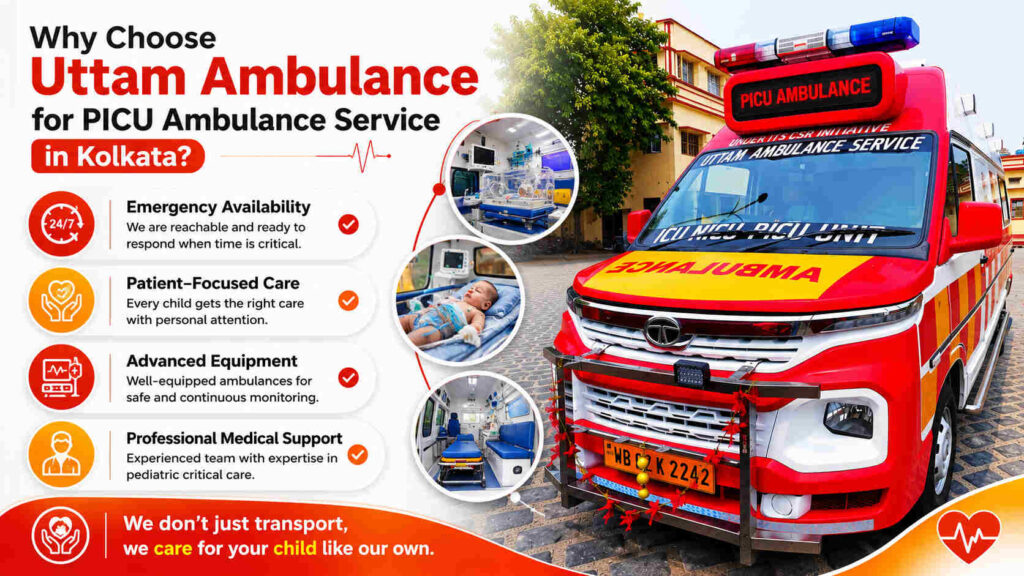
Why Choose Uttam Ambulance for PICU Ambulance Service in Kolkata?

When your child needs critical care transport, you want a provider that takes the responsibility seriously — not just as a transport service, but as an extension of medical care.

At Uttam Ambulance, our approach to pediatric transport is built around a few core priorities:

  • Emergency availability — our team is reachable and ready to respond when time is critical
  • Patient focused care — every transfer is approached with attention to the child’s specific medical condition, not a one size fits all process
  • Equipment readiness — our ambulances are maintained and equipped to support continuous monitoring and critical care needs during transport
  • Professional support — our medical staff bring experience in handling pediatric emergencies with the calm and care that anxious families need in the moment

We understand that when a family calls for a PICU ambulance, they’re not just booking a vehicle — they’re trusting us with one of the most important journeys of their child’s care. That’s a responsibility we take seriously in how we prepare, equip, and staff every transfer.

Areas Covered for PICU Ambulance Service in Kolkata

Uttam Ambulance provides PICU ambulance services across Kolkata and surrounding areas, including hospital to hospital transfer coverage across the city’s major medical facilities. Whether your child needs to be moved within Kolkata or transferred from a nearby location to a hospital in the city, our team is equipped to support that journey.

For families outside central Kolkata, it’s best to confirm coverage for your specific location directly with our team, as service availability can vary depending on distance and hospital destination.

Frequently Asked Questions About PICU Ambulance in Kolkata

  1. What is a PICU ambulance?

 A PICU ambulance is a specially equipped ambulance designed to transport critically ill children who require continuous monitoring and intensive medical support during transit, essentially functioning as a mobile Pediatric Intensive Care Unit.

  1. When does a child need a PICU ambulance?

 A child may need a PICU ambulance in situations involving critical illness, breathing difficulties, ventilator dependency, serious infections, trauma, or when being transferred between hospitals for a higher level of critical care.

  1. What equipment is available in a PICU ambulance?

A PICU ambulance is typically equipped with a ventilator, oxygen support systems, cardiac monitors, a pulse oximeter, infusion pumps, and emergency medications suited for pediatric patients.

  1. How much does a PICU ambulance cost in Kolkata?

Cost depends on factors like distance travelled, the equipment and medical support required, duration of transport, and the level of critical care needed. It’s best to discuss your child’s specific situation with the provider for an accurate estimate.

  1. Does a PICU ambulance provide ventilator support?

Yes, PICU ambulances are equipped with transport ventilators for children who require respiratory support during the journey, ensuring continuity of care from the sending to the receiving facility.

  1. What is the difference between PICU and ICU ambulance?

A PICU ambulance is designed specifically for critically ill children, while an ICU ambulance is designed for adult critical care patients. The equipment sizing, medication dosing, and staff training differ between the two.

  1. Can a PICU ambulance be used for hospital transfer?

Yes, PICU ambulances are commonly used for hospital to hospital transfers when a child needs to be moved to a facility with more specialized pediatric critical care resources, or when continuous monitoring is required during the move.

  1. How can I book a PICU ambulance in Kolkata?

You can book a PICU ambulance by contacting the provider directly, ideally with details about your child’s medical condition so the right equipment and medical team can be arranged in advance.

Final Thoughts — Choosing a Reliable PICU Ambulance in Kolkata

When a child requires critical medical transport, every second matters, and choosing a specialized pediatric transport service can make a vital difference in ensuring safe and continuous care. A dedicated PICU ambulance in Kolkata is designed to meet the unique medical needs of children by combining advanced life support equipment, child friendly emergency facilities, and a trained pediatric critical care team that understands the importance of maintaining stability during transportation. From monitoring critical conditions to providing uninterrupted medical support throughout the journey, specialized pediatric ambulance services help bridge the gap between hospital care and emergency transportation. For families, the priority should always be safety, reliability, and quality of care rather than focusing only on cost. Before arranging pediatric critical care transport, it is important to consider factors such as ambulance equipment, medical staff expertise, response time, and experience in handling pediatric emergencies. If your child needs trusted PICU ambulance services or pediatric critical care transport in Kolkata, Uttam Ambulance is ready to provide professional support with the right resources and compassionate care when it matters most.

NICU Ambulance Cost in Kolkata — What Factors Affect the Price?

The NICU ambulance cost in Kolkata depends on factors such as travel distance, the newborn’s medical condition, the level of neonatal life support equipment required, and the medical team accompanying the baby. Hospital to hospital transfers within Kolkata are generally more affordable, while intercity and interstate neonatal ambulance transfers may cost more due to longer travel distances, specialized equipment, and advanced medical support. A NICU ambulance or neonatal ambulance functions as a mobile Neonatal Intensive Care Unit (NICU), equipped with a transport incubator, neonatal ventilator, oxygen support, vital sign monitors, and trained neonatal medical staff to provide continuous care during transport. This guide explains the NICU ambulance charges in Kolkata, the key factors affecting pricing, possible additional costs, and practical tips for choosing a reliable neonatal ambulance service for safe and timely newborn transport. 

What Is a NICU Ambulance?

Understanding Neonatal Intensive Care Transport

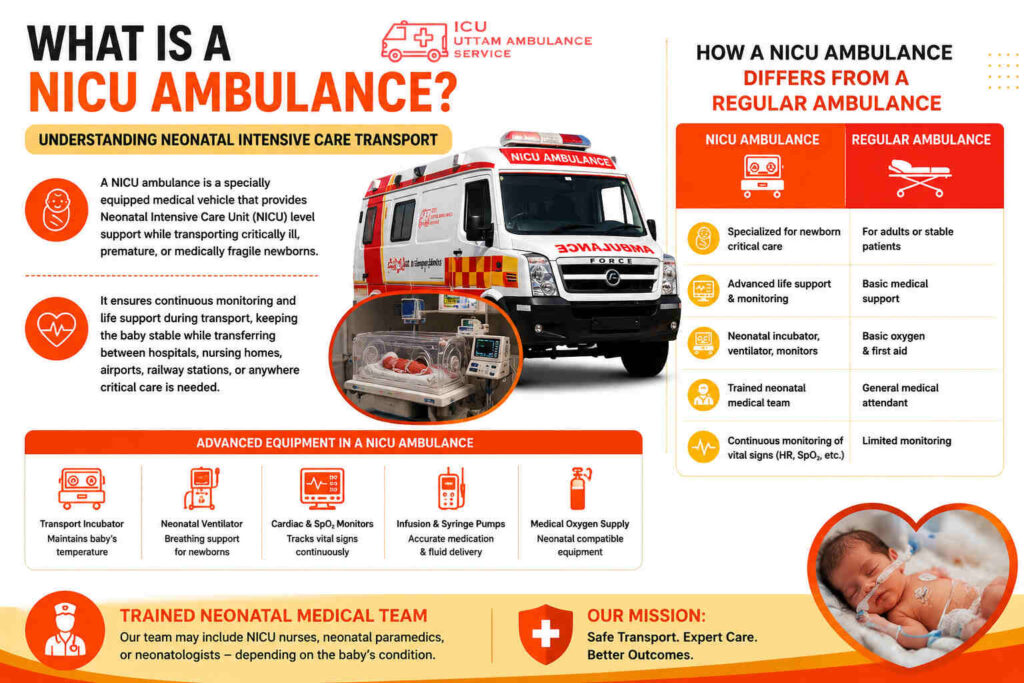
A NICU ambulance, also known as a neonatal ambulance, is a specially equipped medical vehicle designed to provide Neonatal Intensive Care Unit (NICU) level support while transporting critically ill, premature, or medically fragile newborns. Unlike a standard ambulance, it functions as a mobile neonatal intensive care unit, ensuring the baby receives continuous monitoring and life support throughout the journey.

During neonatal transport, a newborn’s body temperature, breathing, heart rate, and oxygen levels can change rapidly. A NICU ambulance is equipped to continuously monitor these vital functions and provide immediate medical support, helping maintain the baby’s stability while being transferred between hospitals, from a nursing home to a higher level NICU facility, or from an airport or railway station to a hospital.

How a NICU Ambulance Differs from a Regular Ambulance

A standard ambulance is primarily designed to transport adult or stable patients with basic medical support. A NICU transport ambulance, however, is specifically equipped for newborn critical care and carries advanced neonatal life support equipment, including:

  • Transport incubator to maintain the baby’s body temperature.
  • Neonatal ventilator for newborns requiring breathing support.
  • Continuous cardiac and oxygen saturation (SpO₂) monitors to track vital signs.
  • Infusion and syringe pumps for accurate medication and fluid delivery.
  • Medical oxygen supply with neonatal compatible equipment.
  • A trained neonatal medical team, which may include a NICU nurse, neonatal paramedic, or neonatologist depending on the baby’s condition.

When Does a Newborn Need a NICU Ambulance?

A newborn ambulance or NICU ambulance is typically required when a baby needs continuous medical supervision during transport. Common situations include:

  • A baby born in a nursing home or smaller hospital requiring transfer to a hospital with a fully equipped NICU.
  • A premature or low birth weight baby needing specialized neonatal intensive care.
  • A newborn requiring advanced surgery or treatment available only at a higher level medical facility.
  • Parents bringing a medically fragile newborn to Kolkata from another city, airport, or railway station.
  • A baby being discharged from the hospital but requiring monitored medical transport to home or another healthcare facility.

In each of these situations, timely access to a properly equipped neonatal ambulance helps ensure safe transportation while minimizing the risks associated with moving a critically ill newborn.

NICU Ambulance Cost in Kolkata

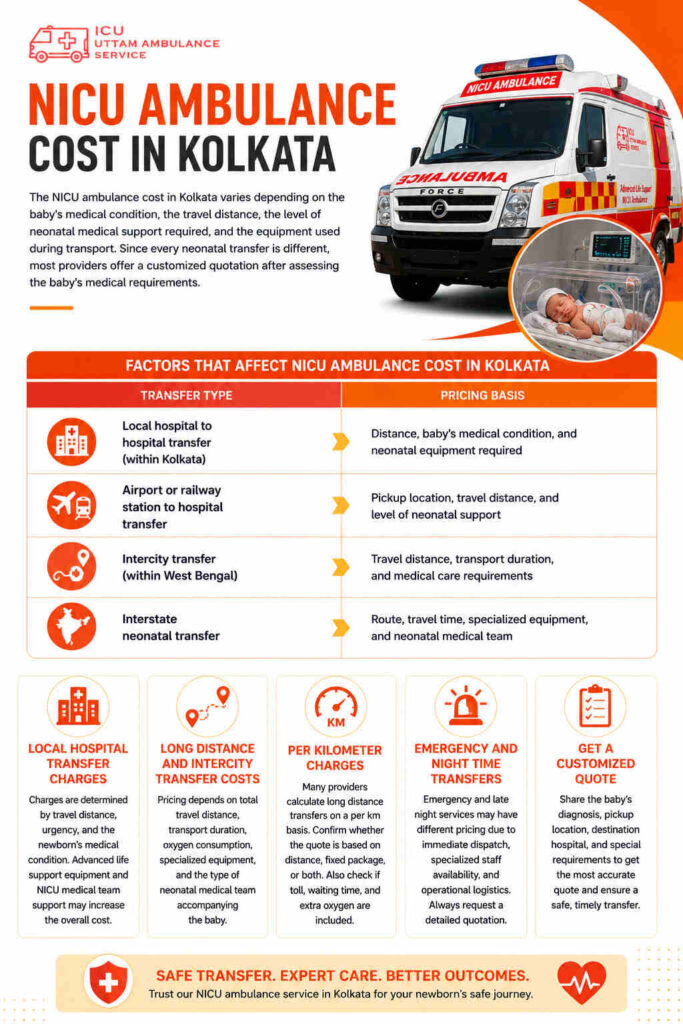
The NICU ambulance cost in Kolkata varies depending on the baby’s medical condition, the travel distance, the level of neonatal medical support required, and the equipment used during transport. While local hospital to hospital transfers are generally more affordable, intercity and interstate neonatal ambulance transfers may cost more because of longer travel time, specialized life support equipment, and the medical team accompanying the newborn. Since every neonatal transfer is different, most providers offer a customized quotation after assessing the baby’s medical requirements. 

Factors That Affect NICU Ambulance Cost in Kolkata
Transfer Type  Pricing Basis 
Local hospital to hospital transfer (within Kolkata)  Distance, baby’s medical condition, and neonatal equipment required 
Airport or railway station to hospital transfer  Pickup location, travel distance, and level of neonatal support 
Intercity transfer (within West Bengal)   Travel distance, transport duration, and medical care requirements 
Interstate neonatal transfer  Route, travel time, specialized equipment, and neonatal medical team 
Local Hospital Transfer Charges

For hospital to hospital transfers within Kolkata, the final NICU ambulance charges are generally determined by the travel distance, urgency of the transfer, and the newborn’s medical condition. If the baby requires advanced life support equipment such as a transport incubator, neonatal ventilator, continuous oxygen support, or monitoring by a trained NICU medical team, the overall cost may increase accordingly.

Long Distance and Intercity Transfer Costs

Intercity and interstate neonatal ambulance transfers require detailed medical planning to ensure the newborn remains stable throughout the journey. Pricing typically depends on factors such as total travel distance, transport duration, oxygen consumption, specialized neonatal equipment, and whether a NICU nurse, neonatal paramedic, or neonatologist is required during transport.

Per Kilometer Charges

Many NICU ambulance service providers in Kolkata calculate long distance transfers on a per kilometer basis, while others offer customized package pricing depending on the route and medical requirements. Before confirming a booking, ask whether the quotation is based on distance, a fixed package, or a combination of both. Also confirm whether toll charges, waiting time, and additional oxygen usage are included in the quoted price.

Emergency and Night Time Transfers

Emergency and late night NICU ambulance services may have different pricing because of immediate vehicle dispatch, availability of specialized neonatal medical staff, and operational logistics. To avoid unexpected costs, request a detailed quotation that clearly lists all inclusions and any additional charges before booking.

Get a Customized Quote

Because every newborn’s medical condition is unique, the most accurate way to determine the NICU ambulance cost in Kolkata is to share the baby’s diagnosis, pickup location, destination hospital, and any special medical requirements with the ambulance provider. This helps ensure that the appropriate neonatal equipment and qualified medical team are arranged for a safe and timely transfer.

What Factors Affect the NICU Ambulance Cost in Kolkata?

The NICU ambulance cost in Kolkata is influenced by several medical and operational factors rather than a single fixed rate. Every neonatal transfer is unique, and the final quotation depends on the newborn’s condition, the distance to be covered, the type of medical equipment required, and the level of care needed during transport. Understanding these factors can help parents compare quotations more confidently and avoid unexpected charges.

Distance Between Hospitals

Travel distance is one of the primary factors affecting NICU ambulance charges in Kolkata. A short hospital to hospital transfer within the city generally costs less than an intercity or interstate transfer because longer journeys involve higher fuel consumption, increased travel time, and extended medical supervision. For example, a transfer from Salt Lake to Park Street is typically less expensive than a transfer from Kolkata to Durgapur or Siliguri.

Type of Medical Equipment Required

The level of neonatal life support equipment required during transport significantly influences the final cost. A stable newborn may require only basic monitoring, while a critically ill or premature baby may need advanced equipment such as a transport incubator, neonatal ventilator, infusion pumps, and continuous cardiac monitoring throughout the journey.

Neonatal Ventilator Requirement

If the newborn requires ventilator support during transport, the overall cost may increase because specialized neonatal ventilators require trained medical professionals to operate and continuously monitor the baby’s breathing during the transfer.

Transport Incubator Availability

A transport incubator helps maintain the newborn’s body temperature during transport, which is particularly important for premature or low birth weight babies. Although it is usually included as part of the NICU ambulance package, its availability and use contribute to the overall pricing.

Oxygen Consumption

Medical oxygen usage is another important pricing factor. Longer journeys or babies requiring higher oxygen flow rates may consume more oxygen during transport, which can influence the total NICU ambulance cost for extended transfers.

Monitoring Equipment

NICU ambulances are equipped with continuous cardiac, blood oxygen (SpO₂), and vital sign monitoring devices. These systems allow the neonatal medical team to monitor the baby’s condition throughout the journey and are typically included in the overall transport package.

Presence of a Neonatologist

Some neonatal transfers require a neonatologist to accompany the ambulance, especially if the newborn is critically ill or requires advanced medical intervention during transport. Because of the specialist’s expertise and availability, this may increase the overall transport cost.

Presence of a NICU Nurse

Many NICU ambulance services include a trained NICU nurse or neonatal paramedic as part of the medical team. In situations requiring additional nursing staff or higher levels of medical supervision, the overall pricing may vary accordingly.

Baby’s Medical Condition

The newborn’s medical condition is one of the most important factors affecting pricing. Babies requiring continuous life support, ventilator assistance, or intensive monitoring generally require more specialized equipment and medical personnel than stable newborns, resulting in higher transport costs.

Time of Transport (Day vs. Night)

Emergency or late night neonatal ambulance transfers may involve different pricing depending on staff availability, immediate dispatch requirements, and operational logistics. Pricing policies vary between providers, so it is advisable to confirm this before booking.

Traffic and Route Conditions

Traffic congestion can increase overall travel time, particularly during peak hours in Kolkata. Longer transport duration may require additional oxygen, extended medical supervision, and increased operational costs, which can influence the final quotation for time sensitive transfers.

Interstate Transfers

Interstate neonatal transfers, such as from Kolkata to Bhubaneswar, usually require longer travel time, route planning, toll payments, and extended medical support. These factors are generally included when preparing a customized quotation for long distance transport.

Toll, Fuel, and Waiting Charges

For outstation transfers, operational expenses such as toll charges, fuel costs, and waiting time may either be included in the package price or billed separately. Before confirming a booking, parents should request a detailed quotation that clearly explains all applicable charges.

What’s Included in the Cost of a NICU Ambulance?

Before comparing NICU ambulance charges in Kolkata, it’s important to understand what is typically included in a standard NICU ambulance package. While inclusions may vary depending on the newborn’s medical condition and the ambulance provider, a properly equipped neonatal ambulance should include the essential life support equipment and trained medical professionals required for safe neonatal transport.

A standard NICU ambulance service generally includes:

  • Transport incubator – Maintains a stable body temperature, especially for premature and low birth weight newborns.
  • Neonatal ventilator – Provides breathing support for babies who cannot breathe independently.
  • Medical oxygen support – Ensures a continuous oxygen supply throughout the transfer when required.
  • Cardiac and vital sign monitoring – Continuously monitors heart rate, oxygen saturation (SpO₂), respiratory status, and other essential vital signs.
  • Syringe and infusion pumps – Deliver medications and intravenous fluids with precise dosing during transport.
  • Emergency neonatal medicines – Basic emergency medications and supplies required for neonatal care during the journey.
  • NICU medical team – Typically includes a trained NICU nurse or neonatal paramedic, with a neonatologist accompanying the transfer when medically required.
Important to Confirm Before Booking

If a quotation appears significantly lower than other providers, ask for a detailed breakdown of what is included in the package. Some lower priced services may not include advanced neonatal equipment, specialist medical staff, or additional oxygen support. Confirming these inclusions in advance helps you compare services accurately and choose the option that best meets your newborn’s medical needs.

Typical NICU Ambulance Cost Scenarios in Kolkata

The NICU ambulance cost in Kolkata varies depending on the transfer route, travel distance, the newborn’s medical condition, and the level of neonatal care required during transport. The examples below are intended for general guidance only. Actual pricing may differ based on the medical equipment used, oxygen requirements, transport duration, and the neonatal medical team accompanying the baby.

Hospital to Hospital Transfer Within Kolkata

A hospital to hospital NICU ambulance transfer within Kolkata is generally the most affordable option because of the shorter travel distance. For example, transferring a newborn from a nursing home in Behala to a NICU facility in central Kolkata usually requires less travel time and fewer operational resources. However, the final cost still depends on whether the baby requires a transport incubator, ventilator support, or continuous medical monitoring.

Airport to Hospital Transfer

Families arriving at Netaji Subhas Chandra Bose International Airport with a newborn requiring immediate neonatal care may need an airport to hospital NICU ambulance. The overall pricing depends on the distance between the airport and the receiving hospital, along with any specialized neonatal equipment and medical support required during the journey.

Kolkata to Durgapur

A NICU ambulance transfer from Kolkata to Durgapur is an intercity journey that involves several hours of travel. The quotation is typically based on the travel distance, transport duration, medical oxygen usage, and the level of neonatal care required throughout the transfer.

Kolkata to Siliguri

A Kolkat to Siliguri neonatal ambulance transfer covers a significantly longer distance and is often priced on a per kilometer basis or through a customized package. Factors such as travel time, neonatal life support equipment, and whether the ambulance is booked for a one way or return trip can influence the final cost.

Kolkata to Bhubaneswar

A NICU ambulance transfer from Kolkata to Bhubaneswar is an interstate journey that usually requires detailed route planning, extended medical supervision, toll payments, and specialized neonatal support. Providers generally prepare a customized quotation after assessing the newborn’s medical condition and transport requirements.

Hidden Charges You Should Ask About Before Booking

Before booking a NICU ambulance in Kolkata, it’s important to understand exactly what is included in the quoted price. While many providers offer transparent pricing, certain operational or medical expenses may be charged separately depending on the transport requirements. Asking the right questions in advance can help you avoid unexpected costs and compare NICU ambulance charges more accurately.

Before confirming your booking, ask whether the quotation includes:

  • Waiting charges – Applicable if the ambulance needs to wait at the referring or receiving hospital for an extended period.
  • Additional oxygen usage – Extra oxygen consumption may be charged separately during long distance transfers or unexpected delays.
  • Toll and parking fees – These charges may apply for intercity or interstate neonatal ambulance transfers if they are not already included in the package.
  • Neonatologist or doctor consultation charges – Confirm whether the specialist doctor’s fee is included or billed separately when a neonatologist accompanies the transport.
  • Additional nursing or medical staff – If an extra NICU nurse or healthcare professional is required, it may affect the final quotation.
  • Extra medical equipment – Ask whether any specialized equipment beyond the standard NICU ambulance package will involve additional charges.
Before You Confirm the Booking

Request a detailed written quotation that clearly lists all inclusions and any potential additional charges. Understanding the complete pricing structure before the transfer helps families make informed decisions and reduces the possibility of unexpected billing during an already stressful situation.

How to Choose the Right NICU Ambulance Service in Kolkata

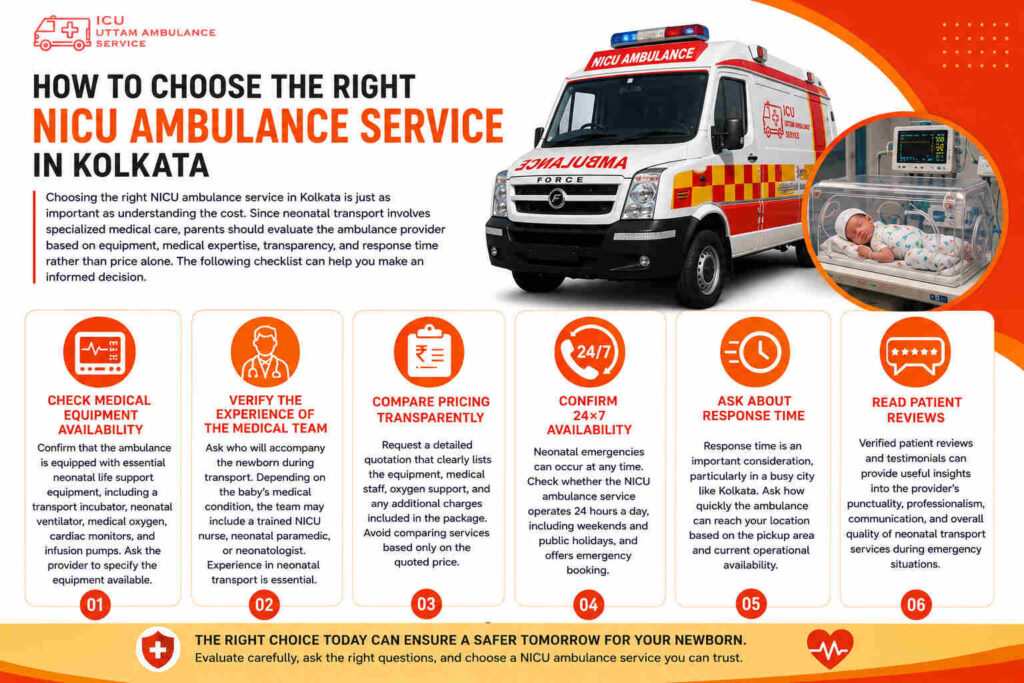
Choosing the right NICU ambulance service in Kolkata is just as important as understanding the cost. Since neonatal transport involves specialized medical care, parents should evaluate the ambulance provider based on equipment, medical expertise, transparency, and response time rather than price alone. The following checklist can help you make an informed decision.

Check Medical Equipment Availability

Confirm that the ambulance is equipped with essential neonatal life support equipment, including a transport incubator, neonatal ventilator, medical oxygen, cardiac monitors, and infusion pumps. Rather than relying on the term “fully equipped,” ask the provider to specify the equipment available for your baby’s transport.

Verify the Experience of the Medical Team

Ask who will accompany the newborn during transport. Depending on the baby’s medical condition, the team may include a trained NICU nurse, neonatal paramedic, or neonatologist. Experience in neonatal intensive care transport is an important factor to consider.

Compare Pricing Transparently

When comparing NICU ambulance charges in Kolkata, request a detailed quotation that clearly lists the equipment, medical staff, oxygen support, and any additional charges included in the package. Comparing services based only on the quoted price may not provide an accurate picture of the overall value.

Confirm 24×7 Availability

Neonatal emergencies can occur at any time. Check whether the NICU ambulance service operates 24 hours a day, including weekends and public holidays, and whether emergency bookings are available on short notice.

Ask About Response Time

Response time is an important consideration, particularly in a busy city like Kolkata. Ask how quickly the ambulance can reach your location based on the pickup area and current operational availability.

Read Patient Reviews

Verified patient reviews and testimonials can provide useful insights into the provider’s punctuality, professionalism, communication, and overall quality of neonatal transport services. They can also help you understand how the team performs during emergency situations.

Questions to Ask Before Booking a NICU Ambulance

Before confirming a NICU ambulance booking, take a few minutes to ask the provider some important questions. This can help you compare NICU ambulance services in Kolkata, understand exactly what is included in the quotation, and avoid unexpected charges during the transfer.

Use this checklist while speaking with the ambulance provider:

  • Is a transport incubator included in the quoted price?
  • Will a neonatologist accompany the transfer, or will the medical team include a trained NICU nurse or neonatal paramedic?
  • Are there any additional or hidden charges that may apply during the journey?
  • Is medical oxygen support included in the package, and are there any limits on oxygen usage?
  • Is the quotation a fixed package, or is the final cost calculated based on distance, travel time, or medical requirements?
  • What is the estimated response time for my location in Kolkata?
  • Which neonatal medical equipment will be available during transport?
  • Will a detailed invoice and documentation be provided for insurance or reimbursement purposes, if required?
Why These Questions Matter

Asking these questions before booking helps parents understand the complete scope of the NICU ambulance service, compare quotations more effectively, and ensure the newborn receives the appropriate medical equipment and professional care during transport. Keeping this checklist readily available can save valuable time during an emergency.

Can Health Insurance Cover NICU Ambulance Costs?

Whether health insurance covers NICU ambulance costs depends on the terms and conditions of your individual insurance policy. Some health insurance plans include ambulance expenses as part of hospitalization benefits, while others may offer coverage only under specific circumstances. Because coverage varies between insurers and policies, it is important to verify the details directly with your insurance provider or Third Party Administrator (TPA).

Cashless vs. Reimbursement

Some health insurance policies may provide cashless ambulance services when the neonatal transfer is arranged through a network hospital. In other cases, families may need to pay the ambulance charges first and later submit a claim for reimbursement. Check with your insurer to understand which option applies to your policy.

Documents Required for Insurance Claims

Although documentation requirements vary by insurer, the following documents are commonly requested when filing an ambulance reimbursement claim:

  • Ambulance service invoice or payment receipt.
  • Doctor’s referral or medical certificate explaining the need for neonatal transport.
  • Hospital admission and discharge records.
  • Any additional claim forms or supporting documents requested by the insurance provider.

Always confirm the exact documentation requirements with your insurer before submitting a claim.

Check Your Policy Before Booking

If the situation allows, contact your insurance provider or TPA before booking the NICU ambulance service to understand what expenses may be covered. However, in a genuine medical emergency, the newborn’s safety should always be the first priority. Insurance documentation and claim formalities can usually be completed after the transfer, subject to your policy terms.

Tips to Reduce NICU Ambulance Costs Without Compromising Safety

Managing the NICU ambulance cost in Kolkata is important, but choosing the lowest priced service should never compromise the newborn’s safety or the quality of medical care. By comparing providers carefully and understanding what is included in the quotation, families can make informed decisions while keeping expenses under control.

Here are some practical ways to reduce NICU ambulance charges without compromising safety:

  • Compare multiple ambulance providers – If time allows, request quotations from two or three NICU ambulance services and compare not only the price but also the equipment, medical team, and services included.
  • Request a detailed cost breakdown – Ask for a written quotation that clearly explains the transport charges, medical equipment, oxygen support, and any additional fees.
  • Confirm the equipment included – Verify that essential neonatal equipment such as a transport incubator, neonatal ventilator, oxygen support, and monitoring devices are included in the quoted package.
  • Coordinate through the referring hospital – Hospitals often work with trusted neonatal ambulance providers and may help arrange an appropriate service based on the baby’s medical needs.
  • Check your health insurance coverage – If the transfer is not an immediate emergency, contact your insurance provider to determine whether any ambulance expenses are covered under your policy.
Choose Value, Not Just the Lowest Price

The objective is not simply to find the cheapest NICU ambulance service, but to choose a provider that offers transparent pricing, appropriate neonatal medical equipment, qualified healthcare professionals, and reliable emergency transport. A well equipped and experienced medical transport team plays an important role in ensuring the newborn’s safety throughout the journey.

Frequently Asked Questions

How much does a NICU ambulance charge per kilometer?

Per kilometer charges vary between ambulance providers and are usually applicable for intercity or long distance neonatal transfers rather than local hospital to hospital transport. Always ask whether the quotation is based on per kilometer pricing, a fixed package, or both.

Is a doctor included in the NICU ambulance cost?

It depends on the ambulance provider and the newborn’s medical condition. Some NICU ambulance services include a neonatologist, while others provide a trained NICU nurse or neonatal paramedic, with a specialist doctor available when medically required.

Is a transport incubator included in the ambulance?

Most NICU ambulance providers include a transport incubator because it is an essential part of neonatal intensive care transport. However, it is always advisable to confirm the available equipment before booking.

What factors increase the NICU ambulance cost?

The main factors affecting NICU ambulance charges include travel distance, ventilator support, specialized neonatal equipment, oxygen consumption, the presence of a neonatologist or additional medical staff, emergency or night time dispatch, and interstate travel.

Does health insurance cover NICU ambulance services?

Insurance coverage depends on your individual health insurance policy. Some insurers provide ambulance coverage through cashless hospitalization or reimbursement, while others may have specific eligibility conditions. Check your policy or speak with your insurer for confirmation.

Are there extra charges for night time transfers?

Some ambulance providers may charge differently for emergency or late night neonatal transfers because of operational and staffing requirements. Always request a detailed quotation and confirm any additional charges before booking.

How long does it take to arrange a NICU ambulance?

The response time depends on your location, ambulance availability, and traffic conditions. Contact the ambulance provider directly for an estimated arrival time based on your pickup location in Kolkata.

Can a newborn be transferred safely between hospitals?

Yes. When a newborn is transported in a properly equipped NICU ambulance with trained neonatal medical professionals and appropriate life support equipment, hospital to hospital transfers are routinely performed while maintaining continuous medical care throughout the journey.

What equipment should a NICU ambulance have?

A properly equipped neonatal ambulance should typically include a transport incubator, neonatal ventilator, oxygen support, cardiac and SpO₂ monitors, syringe and infusion pumps, emergency neonatal medicines, and a qualified NICU medical team.

Conclusion

The NICU ambulance cost in Kolkata depends on several factors, including the travel distance, the newborn’s medical condition, the level of neonatal care required, the medical equipment used during transport, and the healthcare professionals accompanying the baby. Because every neonatal transfer is different, requesting a customized quotation is the best way to understand the expected cost based on your specific requirements.

When choosing a NICU ambulance service, look beyond the quoted price. Confirm that the ambulance is equipped with essential neonatal life support equipment, verify the qualifications of the medical team, and ask for a clear explanation of the services included in the package. Taking a few minutes to compare providers and understand the quotation can help you make an informed decision without compromising your newborn’s safety.

Ultimately, the goal is to ensure safe, timely, and medically supervised neonatal transport. Choosing a reliable and well equipped NICU ambulance service in Kolkata can provide the specialized care and support your baby needs throughout the journey.

Medical Emergencies That Always Require an ICU Ambulance

When someone you love suddenly collapses, struggles to breathe, or shows signs of a stroke, every second matters. In that moment, the question isn’t just “how fast can an ambulance get here?” It’s “will this ambulance actually be able to keep my patient alive during the ride?”

That’s a question most families never think about until they’re living it. Not every ambulance is built the same. A standard ambulance can move a patient from point A to point B safely enough for routine cases — but for someone whose heart, lungs, or brain are in crisis, that’s not enough. These patients need a moving intensive care unit, not just a moving vehicle.

That’s exactly what an ICU ambulance is designed for. In this guide, we’ll walk through what makes an ICU ambulance different, the warning signs that call for one, and the specific medical emergencies where this level of critical care transport isn’t optional — it’s essential.

What Is an ICU Ambulance?

An ICU ambulance is essentially a fully functioning intensive care unit on wheels. Instead of just offering a stretcher and basic first-aid supplies, it’s equipped to actively monitor, stabilize, and treat a patient throughout the entire journey — the same way an ICU ward would inside a hospital.

The difference matters because a patient’s condition doesn’t pause just because they’re being transported. A cardiac patient can go into arrhythmia mid-transit. A trauma patient can start bleeding internally. An ICU ambulance is built to respond to exactly these situations, in real time, without waiting to reach the hospital.

Equipment Found in an ICU Ambulance

A properly equipped ICU ambulance typically carries:

  • A ventilator for patients who can’t breathe independently
  • A cardiac monitor to track heart rhythm and vital signs continuously
  • A defibrillator for sudden cardiac emergencies
  • Oxygen support systems
  • Infusion pumps for precise medication delivery
  • A stock of emergency medicines for immediate intervention

This isn’t just “extra equipment.” Each of these tools exists because critical patients can deteriorate within minutes, and having the right response ready on board can be the difference between a stable arrival and a life lost in transit.

Medical Team Inside an ICU Ambulance

Equipment alone doesn’t save lives — the people operating it do. A proper ICU ambulance is staffed with:

  • A critical care doctor trained to manage emergencies on the move
  • Paramedics experienced in stabilizing trauma and cardiac cases
  • Trained nurses who can assist with continuous monitoring and medication

This team works together the same way an in-hospital ICU team would, just inside a moving vehicle instead of a fixed ward.

ICU Ambulance vs Regular Ambulance

Feature Regular Ambulance ICU Ambulance
Purpose Basic transport Critical care transport
Staff Driver, basic attendant Doctor, paramedics, trained nurse
Equipment First-aid kit, stretcher Ventilator, cardiac monitor, defibrillator, infusion pumps
Best suited for Stable patients, routine transfers Life-threatening conditions, ICU transfers
Monitoring Minimal Continuous, real-time

The gap between the two isn’t small. A regular ambulance can get a patient to the hospital. An ICU ambulance is built to keep them alive long enough to get there.

Signs a Patient May Need an ICU Ambulance

Sometimes it’s obvious a situation is critical. Other times, families aren’t sure whether they’re overreacting or under-reacting. As a general rule, if any of the following are present, it’s safer to call for ICU-level transport:

  • Difficulty breathing or gasping for air
  • Loss of consciousness or unresponsiveness
  • Need for oxygen or ventilator support
  • Severe, unexplained chest pain
  • Sudden slurred speech, facial drooping, or weakness on one side (stroke symptoms)
  • Heavy trauma injuries from an accident or fall
  • A condition that requires continuous medical monitoring
  • Unstable or rapidly changing blood pressure

If you’re ever unsure, it’s better to request an ICU ambulance and have it turn out to be a precaution than to send a regular ambulance for a patient who needed critical support.

10 Medical Emergencies That Always Require an ICU Ambulance

Some emergencies are unpredictable by nature — they can worsen suddenly, without warning, during the exact window when the patient is being moved. These are the situations where ICU-level transport isn’t a luxury; it’s the standard of care.

1. Heart Attack and Severe Cardiac Emergencies

A heart attack can escalate within moments. Sudden chest pain can turn into cardiac arrest, and irregular heart rhythms (arrhythmias) can develop without any prior signs. This is precisely why continuous ECG monitoring and immediate defibrillator access aren’t optional during transport — they’re what keeps a cardiac patient alive between the emergency call and the hospital bed.

2. Stroke and Brain Hemorrhage

With stroke, doctors often talk about the “golden hour” — the narrow window where quick treatment can prevent permanent brain damage. Watch for FAST warning signs: Face drooping, Arm weakness, Speech difficulty, Time to call for help. Because the brain’s oxygen supply is so time-sensitive, rapid, monitored transport can directly affect how much of a patient’s function is preserved.

3. Severe Road Accident Trauma

Trauma from serious accidents often hides more than what’s visible on the surface — internal bleeding, head injuries, spinal damage, and multi-organ trauma can all be present even when a patient looks conscious and stable. These patients frequently need stabilization procedures started before they even reach the hospital, which is only possible inside a properly equipped ICU ambulance.

4. Respiratory Failure or Severe Breathing Problems

Conditions like COPD attacks, severe asthma episodes, or COVID-related respiratory distress can cause oxygen levels to drop dangerously fast. When a patient’s oxygen saturation is falling, a ventilator-equipped ambulance isn’t a “nice-to-have” — it’s the only way to keep breathing support uninterrupted during the ride.

5. Patients on Ventilator Support

Whether it’s an ICU-to-ICU transfer or moving a ventilator-dependent patient from home to hospital, one rule stays constant: their oxygen supply cannot be interrupted, even for a few minutes. Regular ambulances simply aren’t built to sustain this kind of continuous, uninterrupted ventilator support.

6. Organ Failure Emergencies

Kidney failure complications, liver failure, and multi-organ dysfunction all require constant monitoring and precise medication management. These patients’ vitals can shift quickly, and having a critical care team on board means changes can be caught and treated immediately, rather than discovered only after arrival.

7. High-Risk Pregnancy Emergencies

Severe bleeding, eclampsia, and premature labor complications put two lives at risk at once. High-risk pregnancy transport needs continuous maternal and fetal monitoring, along with a medical team ready to respond the moment something changes — something a standard ambulance cannot reliably provide.

8. Serious Burns and Electrical Injuries

Severe burns bring risks that aren’t always obvious right away — significant fluid loss, shock, and breathing complications can all develop during transport. Critical care stabilization en route can meaningfully reduce complications by the time the patient reaches definitive treatment.

9. Poisoning and Drug Overdose Cases

Patients who are unconscious or showing suppressed breathing after poisoning or an overdose are at risk of seizures and airway obstruction. Emergency airway management during transport can be the deciding factor in whether the patient reaches the hospital stable or in crisis.

10. Post-Surgery Critical Patient Transfers

Not every high-risk patient looks critical on the surface. Someone being discharged from ICU, an organ transplant patient, or a person recovering from major surgery can appear stable and still be at real risk of sudden complications. These transfers often call for continued ICU-level monitoring simply as a precaution — because with these cases, “looking fine” and “being fine” aren’t always the same thing.

Risks of Using a Regular Ambulance for Critical Patients

This isn’t about causing alarm — it’s about understanding what’s actually at stake. When a critical patient is transported in a regular ambulance, the risks include:

  • No ventilator support if breathing suddenly worsens
  • Delayed response if a medical emergency happens mid-transit
  • No advanced, continuous monitoring of vitals
  • Limited access to emergency medications if the patient’s condition changes

None of this means regular ambulances aren’t useful — they’re perfectly suited for stable patients and routine transfers. The issue is only when a critical patient ends up in a vehicle that isn’t equipped to handle what their condition actually requires.

How ICU Ambulances Improve Survival Chances

The value of an ICU ambulance comes down to one thing: continuity of care. A patient doesn’t stop being critical the moment they leave the house or hospital room — and their care shouldn’t stop either.

  • Real-time monitoring means changes in condition are caught immediately, not after the fact
  • Faster emergency intervention is possible because the tools and team are already on board
  • Complications during transport are reduced because the patient is being actively managed, not just moved
  • Intercity or long-distance transfers become significantly safer, since the ride itself no longer becomes a period of risk

In critical care, the transport phase should be treated as an extension of hospital care — not a gap in it.

When Should You Call an ICU Ambulance Immediately?

If you’re facing any of the following, don’t wait to assess — call for ICU-level transport right away:

  • The patient is showing any of the emergency symptoms listed earlier in this guide
  • A doctor has specifically recommended ICU-level transport
  • You’re arranging an ICU-to-ICU or hospital-to-hospital transfer
  • The patient is dependent on a ventilator or continuous oxygen

When in doubt, it’s always safer to request an ICU ambulance than to risk moving a critical patient without the right support in place.

What Information Should You Keep Ready Before Booking?

Having the right details ready can save valuable minutes when every second counts:

  • The patient’s current condition and symptoms
  • The current hospital or location
  • Whether oxygen or ventilator support is needed
  • Any relevant medical reports or history
  • The destination hospital
  • Emergency contact details for follow-up coordination

Keeping this information ready in advance means the ambulance team can prepare the right equipment and medical response before they even arrive.

Frequently Asked Questions

How is an ICU ambulance different from a normal ambulance?

An ICU ambulance carries advanced life-support equipment — a ventilator, cardiac monitor, defibrillator, and emergency medicines — along with a trained medical team, including a doctor. A regular ambulance offers basic transport and first-aid support, without continuous critical care monitoring.

Is an ICU ambulance necessary for intercity transport?

Yes, for critical or unstable patients. Longer travel times mean more opportunity for complications to develop, so continuous monitoring and immediate medical response become even more important over intercity distances.

Can ventilator patients travel in a regular ambulance?

No. Ventilator-dependent patients need uninterrupted oxygen support throughout the journey, which only an ICU ambulance equipped with proper ventilator systems and trained staff can reliably provide.

How fast can an ICU ambulance arrive?

Response times depend on your location and current availability, but a well-run ICU ambulance service prioritizes emergency calls and aims to dispatch as quickly as possible, especially for life-threatening situations.

Are ICU ambulances available 24/7?

Reliable ICU ambulance providers operate round the clock, since medical emergencies don’t follow a schedule. Always confirm 24/7 availability with your provider before you need it, not during an emergency.

Conclusion

Medical emergencies rarely give advance notice. Heart attacks, strokes, severe trauma, and respiratory failure can turn a routine day into a life-or-death situation within minutes — and the vehicle that arrives at your door can directly influence the outcome.

An ICU ambulance isn’t about added expense or unnecessary precaution. It’s about making sure a critical patient receives uninterrupted medical care from the very first moment help arrives until they’re safely inside the hospital.

If a loved one is facing a life-threatening medical condition, choosing the right ambulance service can make a critical difference during transport.

Complete Guide to ICU Ambulance Services in Kolkata: Everything You Need to Know

When someone you love is fighting for their life, the minutes between calling for help and reaching a hospital matter more than almost anything else. That’s the simple truth behind every search for an ambulance service in Kolkata. A regular ambulance can move a patient from one place to another, but an ICU ambulance can help keep that patient stable and alive during the journey.

Whether the emergency is happening in central Kolkata, across the river in Howrah, in the busy lanes of Salt Lake, or further out in Barasat or Sodepur, the difference between a basic ambulance and a fully equipped ICU ambulance can genuinely affect what happens next. This guide explains what ICU ambulances actually do, when you may need one, which areas are covered, how intercity transfers from Kolkata to different parts of India are managed, and how to book an ICU ambulance quickly without wasting precious time.

Difference Between Normal Ambulance and ICU Ambulance

Not every ambulance is built the same way, and not every emergency needs the same level of support. Understanding the difference helps you make the right call when every second counts.

A normal ambulance is essentially a transport vehicle. It gets a patient from point A to point B, often with a stretcher, a basic first aid kit, and sometimes an oxygen cylinder. It’s suitable for stable patients who need to reach a clinic or hospital but aren’t in immediate danger.

An ICU ambulance, on the other hand, is a moving critical care unit. It’s built to support patients whose condition could change at any moment during transport — someone on a ventilator, someone recovering from a major cardiac event, or someone being shifted between hospitals for specialised treatment.

Feature Normal Ambulance ICU Ambulance
Purpose Basic patient transport Critical care during transport
Medical Staff Driver, sometimes an attendant Trained paramedics, often with doctor support
Equipment Stretcher, basic oxygen Ventilator, cardiac monitor, defibrillator, infusion pump
Suitable For Stable patients, routine transfers Heart attack, stroke, trauma, ICU-to-ICU transfer
Monitoring Minimal Continuous, real-time vital monitoring

If there’s any doubt about a patient’s stability, it’s always safer to choose an ICU ambulance. The cost difference is small compared to the risk of an under equipped vehicle.

Equipment Available in ICU Ambulances

A properly equipped ICU ambulance carries the same essentials you’d expect inside a hospital’s intensive care unit — just on wheels. Here’s what’s typically on board:

  • Ventilator support for patients who can’t breathe independently
  • Cardiac monitor to track heart rate, blood pressure, and oxygen saturation continuously
  • Oxygen cylinders with backup supply for longer journeys
  • Defibrillator for sudden cardiac emergencies
  • Suction machine to clear airways when needed
  • Infusion pump for precise, continuous delivery of fluids and medication
  • Emergency medicines for immediate intervention
  • Trained paramedics who know how to manage a deteriorating patient mid transit

This is the equipment that separates a true ICU ambulance from a vehicle that simply has “ICU” written on the side.

When Do You Need an ICU Ambulance Service?

Critical Medical Emergencies

Some situations leave no room for a basic vehicle. You’ll typically need an ICU ambulance for:

  • Heart attack cases, where every minute without proper monitoring increases risk
  • Stroke, where rapid, stable transport to a stroke ready hospital matters
  • Accident trauma, especially when internal injuries or heavy blood loss are suspected
  • Organ failure, where continuous support is needed en route
  • ICU patient transfer, when a patient is being moved between hospital ICUs
  • Ventilator patient transport, for anyone who cannot breathe without mechanical support

In each of these cases, the ambulance isn’t just a ride — it’s an extension of the hospital itself.

Inter-Hospital Patient Transfers

A large share of ICU ambulance bookings aren’t first response emergencies at all — they’re planned transfers between hospitals. This happens when a patient needs a specialist not available at their current hospital, when a family wants a second opinion at a different facility, or when a hospital simply doesn’t have an ICU bed available.

During these transfers, the patient still needs the same level of monitoring they’d get inside a hospital ward. A good ICU ambulance team keeps vitals stable, manages any ongoing ventilator support, and stays in communication with both the sending and receiving hospital so there’s no gap in care.

Areas Covered by ICU Ambulance Services in Kolkata

ICU Ambulance Service in Salt Lake Kolkata

Salt Lake’s well planned sectors and wide roads actually work in favour of fast emergency response, but traffic near the major crossings can still slow things down at peak hours. A dedicated ICU ambulance service in Salt Lake Kolkata focuses on quick dispatch from nearby stations and smooth coordination with the hospitals around the area, so patients reach care without unnecessary delays.

ICU Ambulance Service in Howrah

Howrah brings its own challenge: the Howrah Bridge and connecting roads can turn a short distance into a long wait if you’re not prepared. A reliable ambulance service in Howrah plans routes around bridge traffic and peak congestion, keeping both emergency and non-emergency transport options ready around the clock. Whether it’s a sudden cardiac emergency or a scheduled transfer to a Kolkata hospital, local knowledge of Howrah’s routes makes a real difference in response time.

ICU Ambulance Service in Barasat

Barasat and the surrounding suburban belt often face a common problem — fewer large hospitals nearby, which means many critical patients need to be moved into Kolkata for advanced treatment. A responsive ICU ambulance service in this area focuses on two things: reaching the patient quickly, and ensuring the journey into the city is smooth and properly monitored the entire way.

Ambulance Service Sodepur
Sodepur sits a little further from the city centre, which makes local accessibility and dispatch speed especially important. A 24/7 ambulance service Sodepur residents can count on means having vehicles stationed close enough to respond fast, rather than dispatching from far away and losing valuable time in transit.

ICU Ambulance Service in Durgapur

Durgapur is one of the major industrial and residential cities in West Bengal, but during critical medical emergencies, patients often need fast transfer to advanced hospitals in Kolkata or other metro cities. A dependable ICU ambulance service in Durgapur ensures safe and timely patient transport with continuous medical monitoring throughout the journey. Whether it’s a cardiac emergency, accident trauma, ventilator patient transfer, or an inter-hospital ICU shift, trained medical staff and advanced life-support equipment help maintain patient stability during transport.

A professional ICU ambulance service in Durgapur typically includes ventilator support, oxygen cylinders, cardiac monitors, infusion pumps, emergency medicines, and experienced paramedics for critical care management. With 24/7 availability and quick dispatch support, patients can receive immediate medical transportation assistance whenever emergencies arise.

ICU Ambulance from Kolkata to All India

Why Patients Need Intercity ICU Transfers

Not every hospital has access to advanced critical care facilities, and not every city offers the same level of specialist treatment. Many patients require transfer from Kolkata to different parts of India for better medical care, emergency treatment, or specialized procedures.

Patients are commonly shifted for reasons such as:

  • Advanced treatment available only at major hospitals in metro cities
  • Referrals from local doctors to specialized medical centers
  • Emergency patient relocation for surgery or critical care
  • Continuation of ICU level monitoring during long distance travel
  • Safe transfer of ventilator supported or critically ill patients

Such transfers cannot be managed through a regular ambulance service. They require a fully equipped ICU ambulance with trained medical staff capable of handling emergencies throughout the journey.

Facilities Provided During Kolkata to All India ICU Transfer

A professional ICU ambulance service from Kolkata to any location across India should include:

  • Advanced ventilator support for critical patients
  • Continuous oxygen supply with backup cylinders for long,distance travel
  • Cardiac monitor and real time vital monitoring
  • Experienced doctors, nurses, or trained paramedics onboard
  • Emergency medicines and life saving equipment
  • Comfortable patient shifting arrangements for safe transport
  • Coordination with the receiving hospital for smooth admission
Safe and Reliable Long-Distance Patient Transfer

Long distance ICU ambulance transfers from Kolkata to cities across India require careful planning and experienced medical handling. Patient safety is always the highest priority during transport.

Professional ICU ambulance teams focus on:

  • Safe and stable driving during the journey
  • Continuous monitoring of patient condition
  • Quick response to any medical emergency during transit
  • Route planning to reduce unnecessary delays
  • Maintaining communication with family members and hospitals

Whether the patient needs to travel to Delhi, Mumbai, Chennai, Bangalore, Hyderabad, Durgapur, Siliguri, or any other city in India, a properly equipped ICU ambulance ensures safe and uninterrupted critical care throughout the transfer.


Features of a Reliable ICU Ambulance Service

24/7 Availability

Emergencies don’t wait for business hours. A service worth trusting is reachable and ready at 2 PM or 2 AM, every single day.

Experienced Medical Team

Equipment alone doesn’t save lives — people do. Trained paramedics who know how to read a patient’s condition and respond quickly are just as important as the ventilator in the vehicle.

Advanced Life Support System

This includes everything from cardiac monitors to defibrillators, kept in working condition and ready to use the moment they’re needed.

Fast Response Time

The best ICU ambulance service isn’t the one with the most vehicles — it’s the one that reaches you fastest when it matters.

Sanitized and Well Maintained Ambulances

A critical care vehicle should be as clean and well kept as a hospital room. Regular sanitization and maintenance checks aren’t optional extras — they’re basic patient safety.

How to Book an ICU Ambulance in Kolkata

Information Required During Booking

To dispatch the right vehicle and team quickly, you’ll usually be asked for:

  • Patient condition — what’s happening right now
  • Pickup location — exact address or nearest landmark
  • Destination hospital — where the patient needs to go
  • Medical support needed — ventilator, oxygen, doctor assistance, etc.

Having this information ready before you call saves precious time during dispatch.

Emergency Contact Process

  1. Call the emergency line as soon as you recognise the situation needs an ICU ambulance.
  2. Share the patient’s condition and location clearly and calmly.
  3. Confirm the destination hospital, or ask for guidance if you’re unsure where to go.
  4. Stay reachable on the number you called from, in case the team needs more details en route.
  5. Prepare the patient for pickup — keep the path clear and have any medical documents ready if available.

A sticky call button or a one-tap WhatsApp option on a service’s website can shave off valuable seconds when someone is panicking and trying to type out an address.

ICU Ambulance Charges in Kolkata

Factors Affecting Pricing

ICU ambulance pricing isn’t one size fits all. It typically depends on:

  • Distance travelled, whether local or intercity
  • Ventilator requirement and the equipment used during the trip
  • Medical equipment needed on board
  • Doctor support, if a physician accompanies the patient
  • Intercity transfer distance, such as a Kolkata-to-all india trip versus a within-city transfer
Average ICU Ambulance Cost

Because pricing changes based on distance, equipment, and the level of medical support required, it’s best to get a customised quote based on your specific situation rather than relying on a generic number. A trustworthy service will be upfront about costs once they know the patient’s condition and the journey involved — contact them directly for an accurate estimate.

Benefits of Choosing Professional ICU Ambulance Services

Faster Emergency Response

Professional services are built around speed — quick dispatch, trained drivers who know the city’s routes, and teams ready to act the moment they arrive.

Better Patient Survival Chances

Continuous monitoring and immediate intervention during transport can make a measurable difference in outcomes for critical patients.

Safe Long-Distance Transportation

For intercity transfers, professional teams plan routes, manage fuel and equipment backup, and keep the patient stable for hours if needed.

Continuous Critical Care Support

From pickup to hospital handover, a professional ICU ambulance ensures there’s no gap in the level of care a patient receives.

Tips for Choosing the Best Ambulance Service in Kolkata

Check Medical Equipment

Ask specifically what’s on board — a ventilator, cardiac monitor, and defibrillator should be standard, not optional add-ons.

Verify Staff Experience

Trained paramedics make the real difference during an emergency. Don’t hesitate to ask about their training and experience handling critical patients.

Read Reviews and Testimonials

Other patients’ and families’ experiences can tell you a lot about response time, professionalism, and reliability.

Ensure 24/7 Availability

Confirm the service genuinely operates round the clock, not just during standard hours — emergencies have no schedule.

Frequently Asked Questions (FAQs)

What is the cost of ICU ambulance service in Kolkata?

Costs vary based on distance, equipment required, and whether doctor support is needed. It’s best to contact the service directly with your specific situation for an accurate quote.

How quickly can an ICU ambulance arrive?

Response time depends on your location and current traffic conditions, but a reliable service prioritises ICU calls and dispatches the nearest available vehicle immediately.

Is ventilator support available during transport?

Yes, a properly equipped ICU ambulance carries ventilator support along with backup oxygen for the duration of the journey.

Can ICU ambulances travel from Kolkata to all india ?

Yes, ICU ambulances are commonly used for intercity transfers like Kolkata to all india, with continuous monitoring and medical support throughout the trip.

Are trained doctors available in ICU ambulances?

Many ICU ambulance services offer doctor or trained paramedic assistance, especially for critical cases or long-distance transfers. It’s worth confirming this at the time of booking based on the patient’s condition.

Which areas are covered in Kolkata and nearby regions?

ICU ambulance services typically cover Kolkata and surrounding areas including Howrah, Salt Lake, Barasat, and Sodepur, along with intercity routes such as Kolkata to all india .

Conclusion

Medical emergencies can happen without warning, and every minute matters. Whether you need an ICU ambulance service in Kolkata, Howrah, Salt Lake, Barasat, Sodepur, or an ICU ambulance transfer from Kolkata to all india , choosing the right ambulance helps ensure safe transport and continuous critical care.

With ventilator support, advanced life-saving equipment, trained medical staff, and 24/7 availability, ICU ambulances provide the care patients need throughout the journey.

Don’t wait for an emergency to find a reliable ambulance service—save our contact number today.

🚑 Need an ICU Ambulance Right Now?

Call Uttam Ambulance Service for fast dispatch, trained medical professionals, and round-the-clock emergency support.

📞 Call Now: 9163424353 | 9163483982

🌐 Book Online: https://uttamambulance.in/

ICU ambulance arriving for emergency patient transfer in Kolkata

How to Book an ICU Ambulance in Kolkata in Under 5 Minutes

Medical emergencies can happen without warning. A sudden heart attack, stroke, breathing problem, or ICU transfer can leave families stressed, confused, and searching for immediate help. During these situations, every minute matters. Delays in arranging proper emergency transportation can increase health risks for critically ill patients.

That is why fast ICU ambulance booking becomes extremely important.

An ICU ambulance is not just a transport vehicle. It is a moving intensive care unit designed to safely transfer critically ill patients with advanced medical support, oxygen systems, ventilators, and trained paramedics onboard.

If you are searching for a trusted ICU ambulance service in Kolkata, this guide will help you understand how to quickly book an ICU-equipped ambulance in under 5 minutes during emergencies.

Whether you need emergency patient transfer, ventilator ambulance support, or hospital-to-hospital ICU shifting, knowing the correct booking process can save valuable time and help ensure safer patient transportation.

Why Quick ICU Ambulance Booking Is Important During Emergencies

In critical medical situations, fast action can make a major difference in patient survival and recovery. Many families lose valuable time trying to search for emergency ambulance services during panic situations.

A delay of even a few minutes can become dangerous for patients dealing with:

  • Heart attacks
  • Brain strokes
  • Severe breathing difficulties
  • ICU patient transfers
  • Ventilator-dependent conditions
  • Accident trauma injuries

A properly equipped ICU ambulance in Kolkata provides immediate life-support assistance during transportation. Unlike normal ambulances, ICU ambulances are specially designed for critical care transport and continuous patient monitoring.

For example, if a patient suffers a cardiac emergency near Salt Lake or EM Bypass, quick ambulance dispatch with oxygen support and trained medical staff can help stabilize the patient while transferring them to a nearby hospital.

Similarly, ventilator patients being shifted between hospitals require uninterrupted medical support during travel. In these situations, choosing a ventilator-equipped ambulance with emergency medical equipment becomes essential.

Fast ICU ambulance booking helps families:

  • Reduce emergency response time
  • Get advanced life support quickly
  • Ensure safer hospital transfer
  • Avoid panic during emergencies
  • Receive professional medical assistance during transportation

During emergencies, quick decisions and proper medical transportation can save lives.

What Is an ICU Ambulance?

An ICU ambulance is a fully equipped emergency vehicle designed to transport critically ill patients who need continuous medical care during travel.

It works like a mini intensive care unit on wheels. These ambulances are commonly used for emergency patient transport, ventilator support transfers, accident trauma cases, and hospital-to-hospital ICU shifting.

Compared to a regular ambulance, an ICU ambulance in Kolkata includes advanced medical equipment and trained emergency staff to handle serious medical conditions safely.

Booking an ICU ambulance in Kolkata for urgent medical care

1) Ventilator Support:

Many critical patients require breathing assistance during transportation. ICU ambulances often include ventilator systems that help maintain stable oxygen supply throughout the journey.

Ventilator support is especially important for:

  • ICU patients
  • Severe respiratory cases
  • Accident victims
  • Elderly critical patients
2) Oxygen Support System:

Modern ICU ambulances include continuous oxygen support systems for patients suffering from low oxygen levels, breathing distress, or lung-related complications.

Portable oxygen cylinders and oxygen delivery systems help maintain patient stability during emergency transportation.

3) Cardiac Monitoring Equipment:

Patients with heart conditions require continuous monitoring while traveling. ICU ambulances usually include cardiac monitors that track:

  • Heart rate
  • Blood pressure
  • Oxygen saturation
  • Pulse condition

This allows paramedics to respond quickly if the patient’s condition changes.

4) Trained Paramedics & Emergency Staff:

A professional ICU ambulance service includes trained medical staff who understand how to handle emergency situations during patient transport.

Experienced paramedics can:

  • Monitor patient vitals
  • Manage oxygen support
  • Assist during emergencies
  • Coordinate with hospitals
5) Advanced Life Support (ALS) Features:

Many ICU ambulances also function as Advanced Life Support ambulances. These vehicles include:

  • Defibrillators
  • Suction machines
  • Emergency medicines
  • Cardiac care support
  • Advanced monitoring systems

These features make ICU ambulances suitable for critical care transportation across Kolkata.

When Do You Need an ICU Ambulance?

Not every medical situation requires a regular ambulance. Critically ill patients often need advanced life-support transportation for safer travel.

Here are some common situations where booking an ICU ambulance becomes necessary.

i) Heart Attack Patients:

Patients experiencing chest pain, unstable heart conditions, or cardiac arrest require immediate medical monitoring during transportation.

ICU ambulances with cardiac monitoring equipment and oxygen support help manage emergency heart conditions while transferring patients to hospitals.

ii) Stroke Emergencies:

Stroke patients need urgent transportation because delays can affect brain function and recovery.

A critical care ambulance with trained paramedics helps provide stable monitoring during emergency transfer.

iii) ICU Hospital Transfers

Sometimes patients need to be shifted from one hospital to another for specialized treatment.

For example:

  • Transfer from local nursing homes to Apollo Hospital
  • ICU shifting to Fortis Hospital
  • Emergency transfer to Ruby General Hospital

In these cases, ICU-equipped ambulances help ensure safer transportation.

iv) Ventilator Patient Transportation:

Ventilator-dependent patients require uninterrupted breathing support throughout the journey.

A ventilator ambulance in Kolkata ensures continuous respiratory assistance during patient transfer.

vi) Accident & Trauma Cases:

Patients with severe injuries, fractures, head trauma, or internal bleeding often require advanced emergency transportation.

ICU ambulances provide safer patient stabilization during transport.

vii) Severe Breathing Problems:

Patients suffering from asthma attacks, COPD complications, or respiratory distress may require oxygen support ambulances with emergency medical equipment.

Read more: What Are the Warning Signs You Need an ICU Ambulance?

Infographics showing when do you need an ICU Ambulance

How to Book ICU Ambulance in Kolkata in Under 5 Minutes

During emergencies, families often panic because they do not know the booking process. However, arranging an ICU ambulance becomes much easier if you follow the right steps.

Here is a simple step-by-step process to quickly book an ICU ambulance in Kolkata.

Step 1 – Call the Ambulance Helpline:

The fastest way to arrange emergency medical transportation is to contact a trusted ambulance provider directly.

Most professional ambulance services operate 24/7 emergency helplines for immediate response.

While calling:

  • Stay calm
  • Speak clearly
  • Keep patient details ready

Fast communication helps reduce ambulance dispatch time.

Step 2 – Explain the Patient’s Condition:

The ambulance team needs accurate information to arrange proper medical support.

Share important details like:

  • Patient age
  • Breathing condition
  • Oxygen requirement
  • Ventilator support need
  • ICU condition
  • Emergency symptoms

Providing correct information helps dispatch the right ambulance setup quickly.

Step 3 – Share Pickup & Hospital Location:

Always provide:

  • Exact pickup address
  • Nearby landmarks
  • Hospital destination
  • Floor number if applicable

This helps ambulance teams reach the patient faster, especially in busy Kolkata locations like Salt Lake, Howrah, Behala, or Park Circus.

GPS support and clear landmarks can reduce delays significantly.

Step 4 – Confirm ICU Equipment Requirements:

Different patients require different medical support systems.

Before dispatch, confirm whether the patient needs:

  • Ventilator support
  • Oxygen setup
  • Cardiac monitor
  • Stretcher assistance
  • Advanced life support equipment

This ensures the ambulance arrives fully prepared.

Step 5 – Ambulance Dispatch & Safe Patient Transfer:

Once details are confirmed, the ambulance team dispatches the vehicle immediately.

Professional ICU ambulance services usually provide:

  • Estimated arrival time
  • Trained medical staff
  • Continuous patient monitoring
  • Emergency support during transportation

The goal is to ensure safe and stable patient transfer throughout the journey.

Infographics highlighting how to book an ICU Ambulance in Kolkata

Information to Keep Ready Before Booking an ICU Ambulance

Keeping important details ready can help speed up the booking process during emergencies.

Here is a quick checklist families should prepare:

  • Patient name and age
  • Current medical condition
  • Pickup location
  • Hospital destination
  • Contact number
  • Oxygen requirement
  • Ventilator support need
  • Doctor recommendation if available
  • Previous medical history if relevant

Having this information ready helps ambulance teams respond more efficiently.

Features of a Modern ICU Ambulance in Kolkata

Modern ICU ambulances are designed to provide critical care support during transportation.

i) Ventilator Support: Helps patients maintain breathing support during emergency transfers.

ii) Portable Oxygen Cylinder: Provides continuous oxygen flow during transportation.

iii) Defibrillator & Cardiac Monitor: Used for monitoring heart conditions and managing cardiac emergencies.

iv) Suction Machine: Helps clear airway blockages during respiratory emergencies.

v) Emergency Medicines: Many ICU ambulances carry basic emergency medicines and life-saving support systems.

vi) Experienced Medical Team: Professional paramedics and trained medical staff monitor patients throughout the journey for safer transportation.

Areas Covered Across Kolkata

Professional ICU ambulance services often provide emergency coverage across major Kolkata locations, including:

  • Salt Lake
  • New Town
  • Howrah
  • Dum Dum
  • Behala
  • EM Bypass
  • Tollygunge
  • Park Circus

Emergency ambulance support is also commonly available near major hospitals such as:

  • Apollo Hospital
  • Fortis Hospital
  • Ruby General Hospital

This helps ensure faster response during emergencies.

How Much Does ICU Ambulance Service Cost in Kolkata?

ICU ambulance charges in Kolkata may vary depending on several factors.

Common pricing factors include:
  • Distance covered
  • Type of ICU equipment
  • Ventilator requirement
  • Medical staff support
  • Emergency timing
  • Hospital transfer complexity

Patients requiring advanced life support systems or ventilator-equipped ambulances may have higher transportation costs compared to basic ambulance services.

It is always better to confirm service requirements clearly before booking.

Common Mistakes to Avoid While Booking an Ambulance

During emergencies, families often make small mistakes that can delay patient transportation.

i) Waiting Too Long During Emergencies:

Many people waste valuable time searching multiple ambulance numbers instead of booking immediately.

Quick action is important during critical medical situations.

ii) Choosing a Normal Ambulance Instead of ICU Ambulance

Critically ill patients may require ventilator support, oxygen systems, or cardiac monitoring.

Choosing the wrong ambulance type can increase risks during transportation.

iii) Sharing Incorrect Address Information:

Wrong pickup details can delay ambulance arrival.

Always provide accurate landmarks and contact numbers.

iv) Not Explaining the Patient’s Condition Clearly

Incomplete patient information may result in insufficient medical equipment during transportation.

Always explain emergency conditions honestly and clearly.

Why Families Choose Uttam Ambulance in Kolkata

During medical emergencies, families need more than just transportation. They need reliable support, quick response, and safe patient care.

Many families trust Uttam Ambulance because of its:

  • Fast emergency dispatch
  • ICU-equipped ambulances
  • Trained paramedics
  • Oxygen and ventilator support
  • 24/7 ambulance availability
  • Kolkata-wide emergency coverage

The focus remains on patient safety, timely response, and professional emergency care during transportation.

Whether it is a hospital transfer, critical care transport, or emergency patient shifting, professional ambulance support can help reduce stress during difficult situations.

Family booking an ICU ambulance in Kolkata

Conclusion

Medical emergencies are stressful, emotional, and time-sensitive. During these situations, arranging fast and reliable emergency transportation becomes extremely important.

Booking a fully equipped ICU ambulance in Kolkata with trained medical staff, oxygen support, and advanced life-support systems can help ensure safer patient transfer during critical moments.

Whether you need ventilator ambulance support, ICU patient shifting, or emergency hospital transfer, acting quickly can make a major difference.

In emergencies, every second matters. Choosing the right ICU ambulance service can help families receive faster medical transportation support when they need it the most.

Frequently Asked Questions

Q1) How fast can an ICU ambulance arrive in Kolkata?

Response time may vary depending on traffic and location, but professional ambulance services aim for the fastest possible emergency dispatch.

Q2) Do ICU ambulances include ventilator support?

Yes, many ICU ambulances include ventilator support for critically ill patients requiring respiratory assistance.

Q3) Can I book an ICU ambulance online?

Some ambulance providers offer online booking and emergency phone support for faster ambulance dispatch.

Q4) What is the difference between ICU and ALS ambulance?

An ICU ambulance provides intensive care transportation with advanced medical support, while ALS ambulances focus on advanced life-support emergency care.

Q5) Do ICU ambulances have trained paramedics?

Yes, trained paramedics and emergency medical staff are usually available in professional ICU ambulance services.

Q6) Can ICU ambulances transfer patients between hospitals?

Yes, ICU ambulances are commonly used for hospital-to-hospital patient transfers.

Q7) Is oxygen support available in ICU ambulances?

Yes, oxygen support systems are standard features in most ICU-equipped ambulances.

10 warning signs that indicate when to call an ICU ambulance during a medical emergency

When Do You Need an ICU Ambulance? 10 Warning Signs

Let me ask you something — have you ever been in a situation where someone you love suddenly collapsed, and you just… froze? You didn’t know whether to call a regular cab, a basic ambulance, or something more serious? You’re not alone. Millions of families across India face this exact panic every single day.

Here’s the hard truth: calling the wrong type of ambulance can cost precious minutes — and in critical cases, it can cost a life. An ICU ambulance is not just a fancy vehicle. It is a mobile intensive care unit, packed with life-saving equipment and staffed by trained medical professionals who begin treatment the moment they arrive at your door.

So how do you know when to call an ICU ambulance? I’ve put together 10 crystal-clear warning signs that should make your decision easy — and fast.

What Is an ICU Ambulance? 

An ICU ambulance is a specialized emergency vehicle equipped with advanced life-support systems and trained medical personnel. Unlike a standard ambulance, it can provide continuous critical care during transportation, including oxygen therapy, cardiac monitoring, ventilator support, medication administration, and emergency interventions.

ICU ambulances are commonly used for heart attack patients, stroke victims, severe trauma cases, ventilator-dependent patients, newborn emergencies, and inter-hospital transfers requiring intensive medical supervision.

ICU Ambulance vs. Basic Ambulance

A basic ambulance is suitable for stable patients, whereas an ICU ambulance provides advanced life-support and continuous monitoring for critical cases. 

Comparison of ICU ambulance and basic ambulance services and equipment

10 Warning Signs You Need an ICU Ambulance

Let’s get into it. These are the signs you cannot afford to ignore.

Sign 1: Sudden Chest Pain or Pressure

If someone clutches their chest, sweats profusely, and says “it feels like something is sitting on my chest” — that is a heart attack until proven otherwise. Do NOT wait. Do NOT drive them yourself. A cardiac patient needs continuous monitoring, oxygen, and immediate intervention the moment help arrives. An ICU ambulance gives them that.

Sign 2: Loss of Consciousness or Unresponsiveness

They are not asleep. They are not “just tired.” If a person suddenly becomes unresponsive, cannot be woken up, or collapses — this is a neurological or cardiac emergency. ICU-level care needs to begin within minutes, not after you park the car at the hospital gate.

Sign 3: Difficulty Breathing or Severe Breathlessness

Watching someone gasp for air is terrifying. Whether it’s due to a severe asthma attack, COPD flare-up, pneumonia, or pulmonary edema — if the patient is struggling to breathe and their lips are turning bluish (a condition called cyanosis), they need oxygen therapy and possibly a ventilator. Only an ICU ambulance carries that.


Pulse oximeter showing low oxygen saturation during a breathing emergency

Sign 4: Stroke Symptoms (FAST Rule)

Remember FAST: Face drooping, Arm weakness, Speech difficulty, Time to call! Stroke is a brain emergency. Every minute without treatment, nearly 2 million brain cells die. An ICU ambulance team can stabilize the patient and alert the hospital ahead — so treatment begins the second they arrive.

Sign 5: Severe Injuries from Accidents

Major road accidents, falls from height, industrial injuries — these patients are often in shock, losing blood rapidly, with possible internal bleeding or spinal damage. Moving them carelessly can cause permanent paralysis. ICU ambulance teams are trained to immobilize, stabilize, and monitor throughout the journey.

Sign 6: Seizures That Don’t Stop

A single short seizure may not be an emergency. But if the seizure lasts more than 5 minutes, if the person doesn’t regain consciousness between seizures, or if it is their first-ever seizure — you need an ICU ambulance immediately. This is called status epilepticus and it can be fatal without rapid medical intervention.

Sign 7: Premature Newborn or Neonatal Emergency

A premature baby or a newborn with breathing problems, jaundice, or infection needs a NICU ambulance — a specialized ICU ambulance for babies. These tiny patients cannot survive transport in a regular ambulance. ICU Uttam Ambulance provides dedicated NICU ambulance services for newborns across West Bengal.

NICU ambulance transporting a premature newborn requiring specialized medical care

Sign 8: Diabetic Emergency — Very High or Very Low Sugar

Diabetic ketoacidosis (DKA) or severe hypoglycemia can both lead to coma and death if untreated. If the patient is unconscious, confused, or vomiting with extremely high or low blood sugar, IV treatment must begin immediately — something only an ICU ambulance team can provide en route to the hospital.

Sign 9: Poisoning or Drug Overdose

Whether it’s accidental poisoning, medication overdose, or chemical exposure — these patients can deteriorate rapidly. Their airway can get blocked, their heart rhythm can go erratic, and they may need immediate antidotes or intubation. This is a 100% ICU ambulance situation.

Sign 10: Post-Surgery Patient Transfer Requiring ICU-Level Care

If a patient is being transferred from one hospital to another after surgery — especially if they are on a ventilator or have drains and IV lines — they need an ICU ambulance, not a tempo traveler. Any bump in monitoring during transfer can be fatal. Only a fully equipped ICU ambulance can ensure a safe transfer.

Infographic showing 10 warning signs that indicate when an ICU ambulance may be needed

Real-Life Example: Why Choosing the Right Ambulance Matters

Imagine a 68-year-old patient in Kolkata suddenly develops severe chest pain, sweating, and breathlessness. Family members often think driving directly to the hospital will save time.

However, if the patient suffers a cardiac arrest on the way, a private vehicle cannot provide oxygen therapy, cardiac monitoring, or life-saving defibrillation.

An ICU ambulance allows treatment to begin immediately while the patient is being transported, helping ensure continuous medical care during a critical emergency.

When Is a Basic Ambulance Sufficient?

While ICU ambulances are essential for critically ill patients, not every medical situation requires intensive care during transport. In many non-emergency cases, a basic ambulance can provide safe and cost-effective patient transportation.

A basic ambulance may be suitable for:

  • Routine hospital discharge
  • Stable patients requiring non-emergency transfers
  • Minor injuries without serious complications
  • Scheduled medical appointments or treatments
  • Patients who do not require continuous monitoring or advanced life-support equipment

If the patient is conscious, stable, breathing normally, and not at risk of sudden deterioration, a basic ambulance may be the appropriate choice.

If you’re unsure which ambulance type is needed, explain the patient’s condition to the ambulance provider. They can help determine whether a basic ambulance or an ICU ambulance is the safest option.

Frequently Asked Questions (FAQ)

Q1. What situations require an ICU ambulance?

Ans – An ICU ambulance is typically required for patients experiencing heart attacks, strokes, severe breathing difficulties, major accidents, unconsciousness, ventilator dependency, neonatal emergencies, or other life-threatening medical conditions that require continuous monitoring and advanced medical support during transport.

Q2. How is an ICU ambulance different from a regular ambulance?

Ans –  A regular ambulance is mainly used for patient transportation and basic medical assistance. An ICU ambulance is equipped with advanced life-support systems such as ventilators, cardiac monitors, defibrillators, oxygen support, and trained medical professionals to provide critical care during transit.

Q3. Should I drive a critical patient to the hospital myself?

Ans –  In most serious medical emergencies, self-transport is not recommended. Critical patients may require oxygen support, cardiac monitoring, medication, or emergency interventions while travelling to the hospital. An ICU ambulance can provide immediate medical care during transport.

Q4. Can an ICU ambulance transport patients on ventilator support?

Ans – Yes. ICU ambulances are specifically designed to transport ventilator-dependent patients safely. They are equipped with ventilators, oxygen systems, monitoring equipment, and trained medical staff to manage critical patients throughout the journey.

Q5. When is a basic ambulance sufficient instead of an ICU ambulance?

Ans –  A basic ambulance may be suitable for stable patients, routine hospital discharges, scheduled medical appointments, and non-emergency transfers where continuous monitoring or advanced life-support equipment is not required.

Q6. What should I do if I am unsure which ambulance type is needed?

Ans –  If you are unsure, contact the ambulance service and explain the patient’s condition, symptoms, and medical history. The provider can help determine whether a basic ambulance or an ICU ambulance is the safest option based on the patient’s needs.

Uttam Ambulance ICU transport service in West Bengal

Conclusion:

Here’s the thing about medical emergencies: they rarely announce themselves politely. They strike fast, they escalate faster, and every second you spend wondering “is this serious enough?” is a second that could matter enormously.

If you see even one of the 10 warning signs listed above — pick up the phone. Call for an ICU ambulance. It is always better to call and not need it than to need it and not call.

ICU Uttam Ambulance Service has been the trusted partner of thousands of families across West Bengal for over 25 years. Our team is trained, our vehicles are fully equipped, and we are available 24/7 — every single day of the year.

🚨 Save This Number Right Now — You Might Need It Someday

ICU Uttam Ambulance Service 📱 9836035945 | 9163483982 🌐 uttamambulance.in

📍 Serving all of West Bengal | Available 24/7 | 10–15 Min Response