
Jul 2026
When someone you love suddenly collapses, struggles to breathe, or shows signs of a stroke, every second matters. In that moment, the question isn’t just “how fast can an ambulance get here?” It’s “will this ambulance actually be able to keep my patient alive during the ride?”
That’s a question most families never think about until they’re living it. Not every ambulance is built the same. A standard ambulance can move a patient from point A to point B safely enough for routine cases — but for someone whose heart, lungs, or brain are in crisis, that’s not enough. These patients need a moving intensive care unit, not just a moving vehicle.
That’s exactly what an ICU ambulance is designed for. In this guide, we’ll walk through what makes an ICU ambulance different, the warning signs that call for one, and the specific medical emergencies where this level of critical care transport isn’t optional — it’s essential.
What Is an ICU Ambulance?
An ICU ambulance is essentially a fully functioning intensive care unit on wheels. Instead of just offering a stretcher and basic first-aid supplies, it’s equipped to actively monitor, stabilize, and treat a patient throughout the entire journey — the same way an ICU ward would inside a hospital.
The difference matters because a patient’s condition doesn’t pause just because they’re being transported. A cardiac patient can go into arrhythmia mid-transit. A trauma patient can start bleeding internally. An ICU ambulance is built to respond to exactly these situations, in real time, without waiting to reach the hospital.
Equipment Found in an ICU Ambulance
A properly equipped ICU ambulance typically carries:
- A ventilator for patients who can’t breathe independently
- A cardiac monitor to track heart rhythm and vital signs continuously
- A defibrillator for sudden cardiac emergencies
- Oxygen support systems
- Infusion pumps for precise medication delivery
- A stock of emergency medicines for immediate intervention
This isn’t just “extra equipment.” Each of these tools exists because critical patients can deteriorate within minutes, and having the right response ready on board can be the difference between a stable arrival and a life lost in transit.
Medical Team Inside an ICU Ambulance
Equipment alone doesn’t save lives — the people operating it do. A proper ICU ambulance is staffed with:
- A critical care doctor trained to manage emergencies on the move
- Paramedics experienced in stabilizing trauma and cardiac cases
- Trained nurses who can assist with continuous monitoring and medication
This team works together the same way an in-hospital ICU team would, just inside a moving vehicle instead of a fixed ward.
ICU Ambulance vs Regular Ambulance
| Feature | Regular Ambulance | ICU Ambulance |
| Purpose | Basic transport | Critical care transport |
| Staff | Driver, basic attendant | Doctor, paramedics, trained nurse |
| Equipment | First-aid kit, stretcher | Ventilator, cardiac monitor, defibrillator, infusion pumps |
| Best suited for | Stable patients, routine transfers | Life-threatening conditions, ICU transfers |
| Monitoring | Minimal | Continuous, real-time |
The gap between the two isn’t small. A regular ambulance can get a patient to the hospital. An ICU ambulance is built to keep them alive long enough to get there.
Signs a Patient May Need an ICU Ambulance
Sometimes it’s obvious a situation is critical. Other times, families aren’t sure whether they’re overreacting or under-reacting. As a general rule, if any of the following are present, it’s safer to call for ICU-level transport:
- Difficulty breathing or gasping for air
- Loss of consciousness or unresponsiveness
- Need for oxygen or ventilator support
- Severe, unexplained chest pain
- Sudden slurred speech, facial drooping, or weakness on one side (stroke symptoms)
- Heavy trauma injuries from an accident or fall
- A condition that requires continuous medical monitoring
- Unstable or rapidly changing blood pressure
If you’re ever unsure, it’s better to request an ICU ambulance and have it turn out to be a precaution than to send a regular ambulance for a patient who needed critical support.
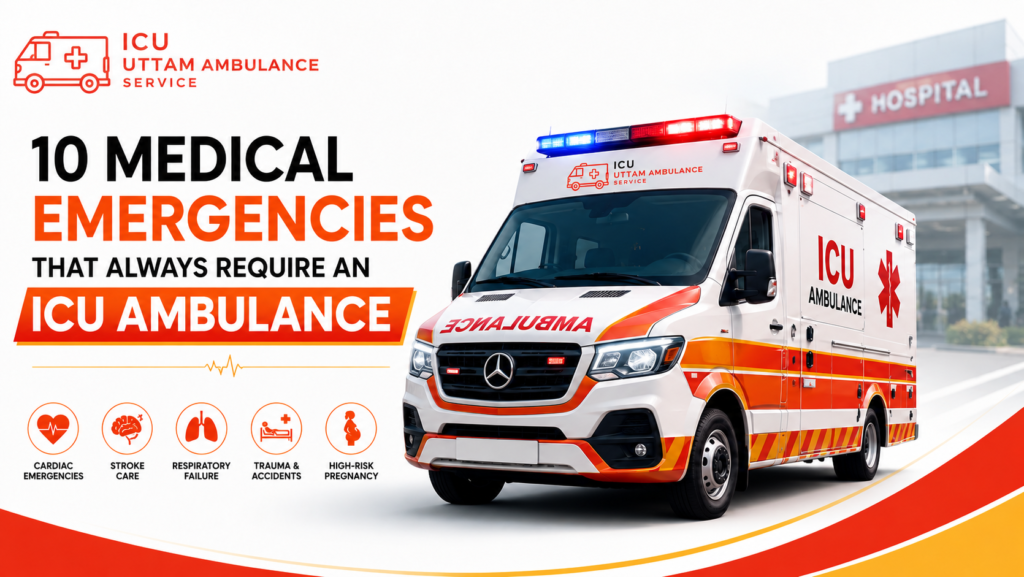
10 Medical Emergencies That Always Require an ICU Ambulance
Some emergencies are unpredictable by nature — they can worsen suddenly, without warning, during the exact window when the patient is being moved. These are the situations where ICU-level transport isn’t a luxury; it’s the standard of care.
1. Heart Attack and Severe Cardiac Emergencies
A heart attack can escalate within moments. Sudden chest pain can turn into cardiac arrest, and irregular heart rhythms (arrhythmias) can develop without any prior signs. This is precisely why continuous ECG monitoring and immediate defibrillator access aren’t optional during transport — they’re what keeps a cardiac patient alive between the emergency call and the hospital bed.
2. Stroke and Brain Hemorrhage
With stroke, doctors often talk about the “golden hour” — the narrow window where quick treatment can prevent permanent brain damage. Watch for FAST warning signs: Face drooping, Arm weakness, Speech difficulty, Time to call for help. Because the brain’s oxygen supply is so time-sensitive, rapid, monitored transport can directly affect how much of a patient’s function is preserved.
3. Severe Road Accident Trauma
Trauma from serious accidents often hides more than what’s visible on the surface — internal bleeding, head injuries, spinal damage, and multi-organ trauma can all be present even when a patient looks conscious and stable. These patients frequently need stabilization procedures started before they even reach the hospital, which is only possible inside a properly equipped ICU ambulance.
4. Respiratory Failure or Severe Breathing Problems
Conditions like COPD attacks, severe asthma episodes, or COVID-related respiratory distress can cause oxygen levels to drop dangerously fast. When a patient’s oxygen saturation is falling, a ventilator-equipped ambulance isn’t a “nice-to-have” — it’s the only way to keep breathing support uninterrupted during the ride.
5. Patients on Ventilator Support
Whether it’s an ICU-to-ICU transfer or moving a ventilator-dependent patient from home to hospital, one rule stays constant: their oxygen supply cannot be interrupted, even for a few minutes. Regular ambulances simply aren’t built to sustain this kind of continuous, uninterrupted ventilator support.
6. Organ Failure Emergencies
Kidney failure complications, liver failure, and multi-organ dysfunction all require constant monitoring and precise medication management. These patients’ vitals can shift quickly, and having a critical care team on board means changes can be caught and treated immediately, rather than discovered only after arrival.
7. High-Risk Pregnancy Emergencies
Severe bleeding, eclampsia, and premature labor complications put two lives at risk at once. High-risk pregnancy transport needs continuous maternal and fetal monitoring, along with a medical team ready to respond the moment something changes — something a standard ambulance cannot reliably provide.
8. Serious Burns and Electrical Injuries
Severe burns bring risks that aren’t always obvious right away — significant fluid loss, shock, and breathing complications can all develop during transport. Critical care stabilization en route can meaningfully reduce complications by the time the patient reaches definitive treatment.
9. Poisoning and Drug Overdose Cases
Patients who are unconscious or showing suppressed breathing after poisoning or an overdose are at risk of seizures and airway obstruction. Emergency airway management during transport can be the deciding factor in whether the patient reaches the hospital stable or in crisis.
10. Post-Surgery Critical Patient Transfers
Not every high-risk patient looks critical on the surface. Someone being discharged from ICU, an organ transplant patient, or a person recovering from major surgery can appear stable and still be at real risk of sudden complications. These transfers often call for continued ICU-level monitoring simply as a precaution — because with these cases, “looking fine” and “being fine” aren’t always the same thing.
Risks of Using a Regular Ambulance for Critical Patients
This isn’t about causing alarm — it’s about understanding what’s actually at stake. When a critical patient is transported in a regular ambulance, the risks include:
- No ventilator support if breathing suddenly worsens
- Delayed response if a medical emergency happens mid-transit
- No advanced, continuous monitoring of vitals
- Limited access to emergency medications if the patient’s condition changes
None of this means regular ambulances aren’t useful — they’re perfectly suited for stable patients and routine transfers. The issue is only when a critical patient ends up in a vehicle that isn’t equipped to handle what their condition actually requires.
How ICU Ambulances Improve Survival Chances
The value of an ICU ambulance comes down to one thing: continuity of care. A patient doesn’t stop being critical the moment they leave the house or hospital room — and their care shouldn’t stop either.
- Real-time monitoring means changes in condition are caught immediately, not after the fact
- Faster emergency intervention is possible because the tools and team are already on board
- Complications during transport are reduced because the patient is being actively managed, not just moved
- Intercity or long-distance transfers become significantly safer, since the ride itself no longer becomes a period of risk
In critical care, the transport phase should be treated as an extension of hospital care — not a gap in it.
When Should You Call an ICU Ambulance Immediately?
If you’re facing any of the following, don’t wait to assess — call for ICU-level transport right away:
- The patient is showing any of the emergency symptoms listed earlier in this guide
- A doctor has specifically recommended ICU-level transport
- You’re arranging an ICU-to-ICU or hospital-to-hospital transfer
- The patient is dependent on a ventilator or continuous oxygen
When in doubt, it’s always safer to request an ICU ambulance than to risk moving a critical patient without the right support in place.
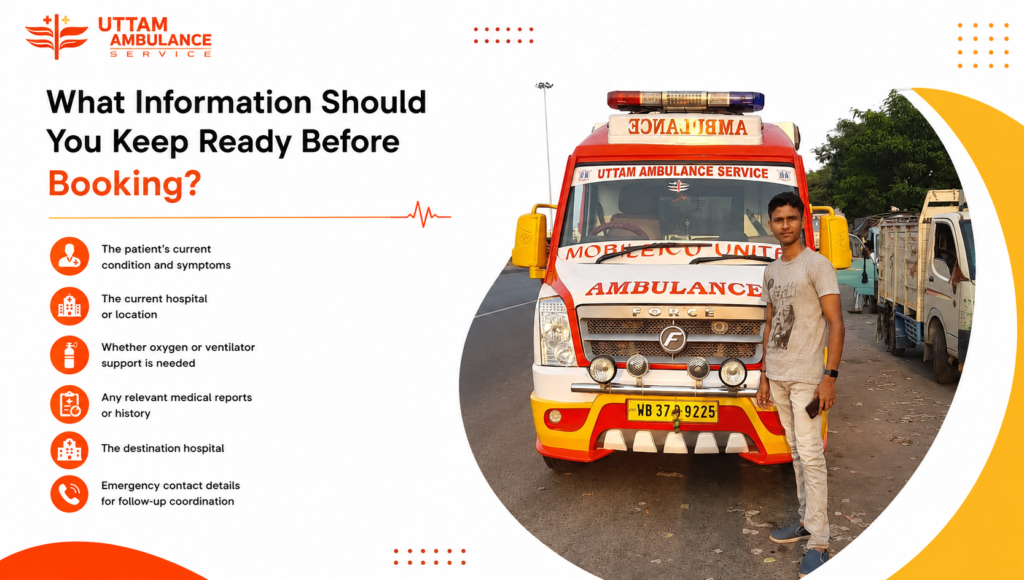
What Information Should You Keep Ready Before Booking?
Having the right details ready can save valuable minutes when every second counts:
- The patient’s current condition and symptoms
- The current hospital or location
- Whether oxygen or ventilator support is needed
- Any relevant medical reports or history
- The destination hospital
- Emergency contact details for follow-up coordination
Keeping this information ready in advance means the ambulance team can prepare the right equipment and medical response before they even arrive.
Frequently Asked Questions
How is an ICU ambulance different from a normal ambulance?
An ICU ambulance carries advanced life-support equipment — a ventilator, cardiac monitor, defibrillator, and emergency medicines — along with a trained medical team, including a doctor. A regular ambulance offers basic transport and first-aid support, without continuous critical care monitoring.
Is an ICU ambulance necessary for intercity transport?
Yes, for critical or unstable patients. Longer travel times mean more opportunity for complications to develop, so continuous monitoring and immediate medical response become even more important over intercity distances.
Can ventilator patients travel in a regular ambulance?
No. Ventilator-dependent patients need uninterrupted oxygen support throughout the journey, which only an ICU ambulance equipped with proper ventilator systems and trained staff can reliably provide.
How fast can an ICU ambulance arrive?
Response times depend on your location and current availability, but a well-run ICU ambulance service prioritizes emergency calls and aims to dispatch as quickly as possible, especially for life-threatening situations.
Are ICU ambulances available 24/7?
Reliable ICU ambulance providers operate round the clock, since medical emergencies don’t follow a schedule. Always confirm 24/7 availability with your provider before you need it, not during an emergency.
Conclusion
Medical emergencies rarely give advance notice. Heart attacks, strokes, severe trauma, and respiratory failure can turn a routine day into a life-or-death situation within minutes — and the vehicle that arrives at your door can directly influence the outcome.
An ICU ambulance isn’t about added expense or unnecessary precaution. It’s about making sure a critical patient receives uninterrupted medical care from the very first moment help arrives until they’re safely inside the hospital.
If a loved one is facing a life-threatening medical condition, choosing the right ambulance service can make a critical difference during transport.





Leave a Reply